Introducing AutoStack 2.0
Published on September 15, 2026 • 4 min

Today I'm excited to launch AutoStack 2.0. This is the biggest thing we've ever shipped.
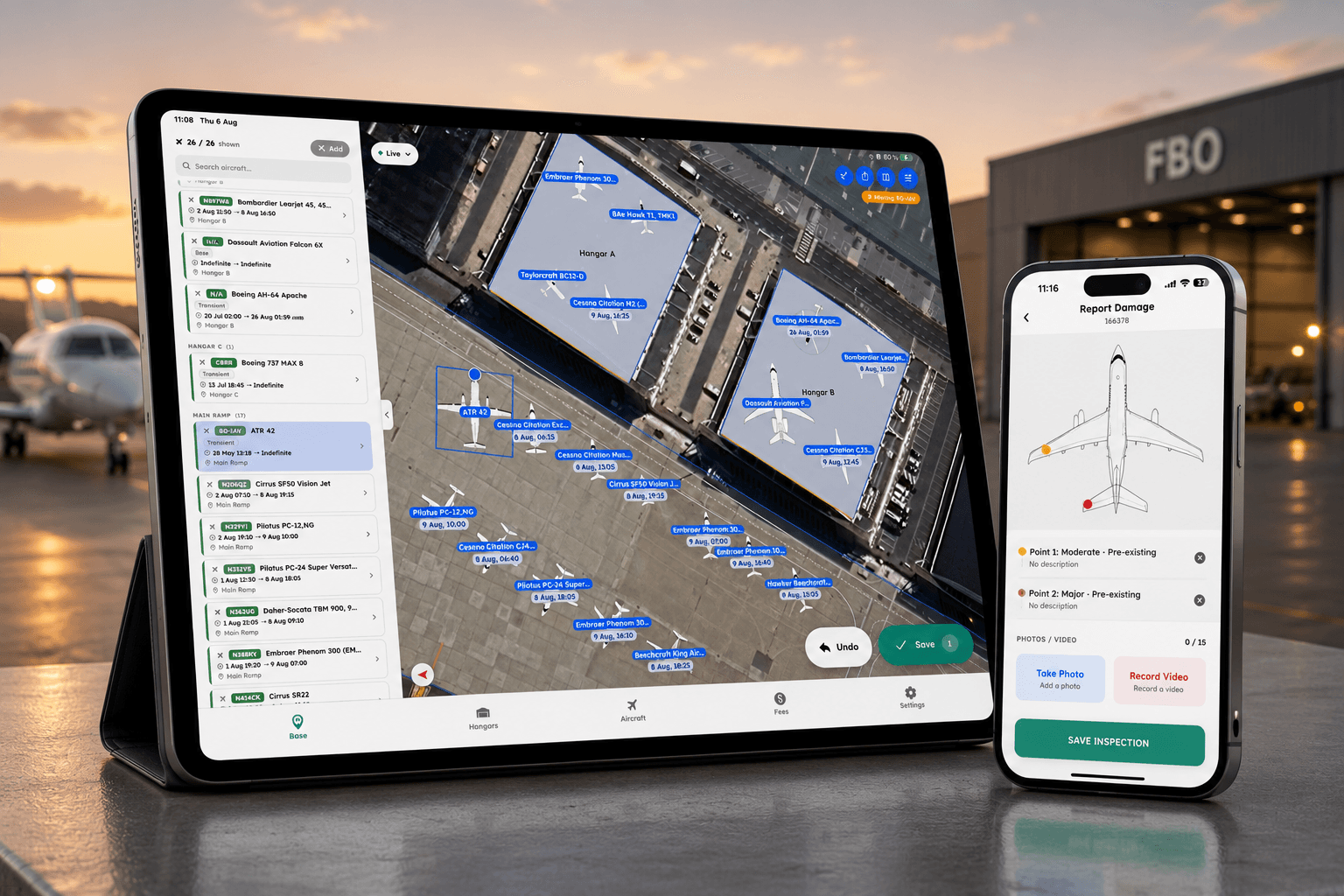
We didn't tune the old stacker. We threw it out and built a world model from the ground up, an engine that understands your hangar as a real building and your aircraft as real objects that have to get towed through it, around your obstacles and out your doors. Call it AI for towing.
It beats the old engine on every benchmark we track: accuracy, utilization, and speed. And almost all of it came straight off your feature requests.
The three big updates:
- Time awareness. It stacks in departure order, so your team moves fewer aircraft.
- Speed. It's 50 times faster, and it typically runs in under two seconds.
- Much better world understanding. It knows how real objects move, how to route around obstacles, how to use multiple doors when you have them, and how your garage doors work. More accurate towing simulation means more utilization.
It's on for every base right now, so there's nothing you need to turn on. We've had it running on real bases since July, which is most of the reason it took until now.
Take a quick tour
You can see it in action here.
Five aircraft in tow order, then a ten aircraft run at 1.8 seconds, then the thirty-two aircraft building.
Want to see it run on your hangar?
AutoStack 2.0 is already on for every AirPlx base. If you'd rather have us walk you through it on your own building, with your tugs and your schedule, get on a call with us and we'll run it with you.
Book a walkthroughIt minimizes movements
AutoStack 2.0 takes the departure time for every aircraft in the building and stacks in departure order. That minimizes the number of movements your team has to make. The plane leaving at dawn sits by the door. The one that isn't moving until the 19th goes to the back.
Fewer movements is the whole point. Fewer tows is safer, and it's a lot easier to run operationally. Nobody is digging a Global out at 0500 to get at something behind it.
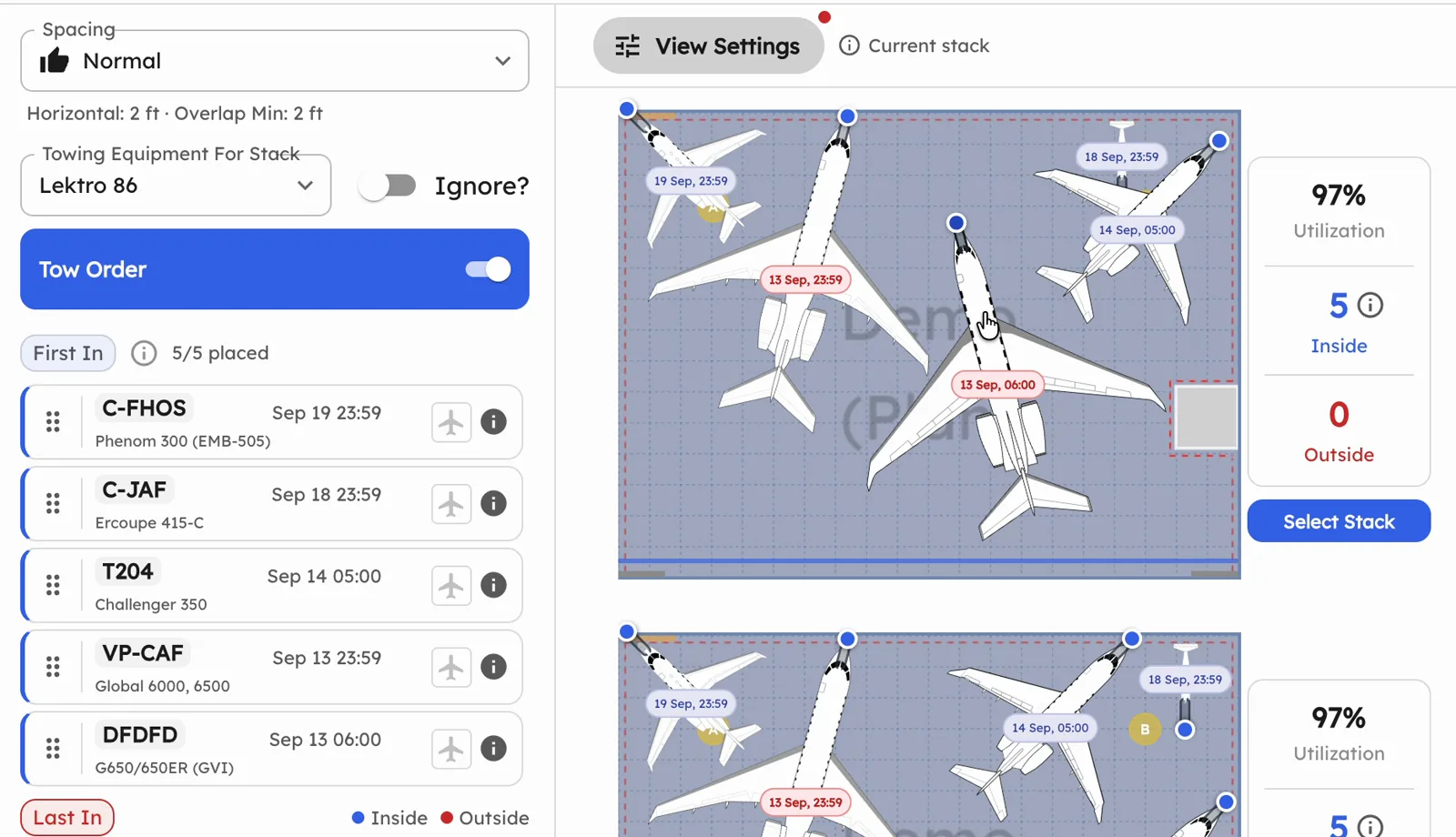
The G650 leaves at 0600 tomorrow so it goes in last, right by the door. The Phenom isn't going anywhere until the 19th, so it's in the back. Five aircraft, five inside, none outside.
It's about 50 times faster
Both engines started at once on the same hangar. 2.0 was done in 1.6 seconds. The old one finished in 57.3.

We're not claiming time travel. We're claiming 1.4 seconds.
The second thing you'll notice is that it's really fast. The runs in this post finished in 1.4 and 1.8 seconds. The thirty-aircraft hangar further down took about ten.
What that means is you can change things on the fly and just run it again. Change the tow order, flip the orientation of an aircraft, swap the tug, change your spacing SOPs, and you get results back right away. That's the difference between stacking being something you do once and something you can sit with and work through.
- Swap the tug and re-run. A Lektro 88i and a Mototok TWIN 3900 NG don't turn the same way, and the layout shouldn't pretend they do
- Change the spacing preset between Normal, Tight and Loose, or set your own horizontal clearance and minimum overlap
- Ignore the tug entirely if you just want to know the theoretical ceiling
- Every run gets saved, so you can page back through them and compare
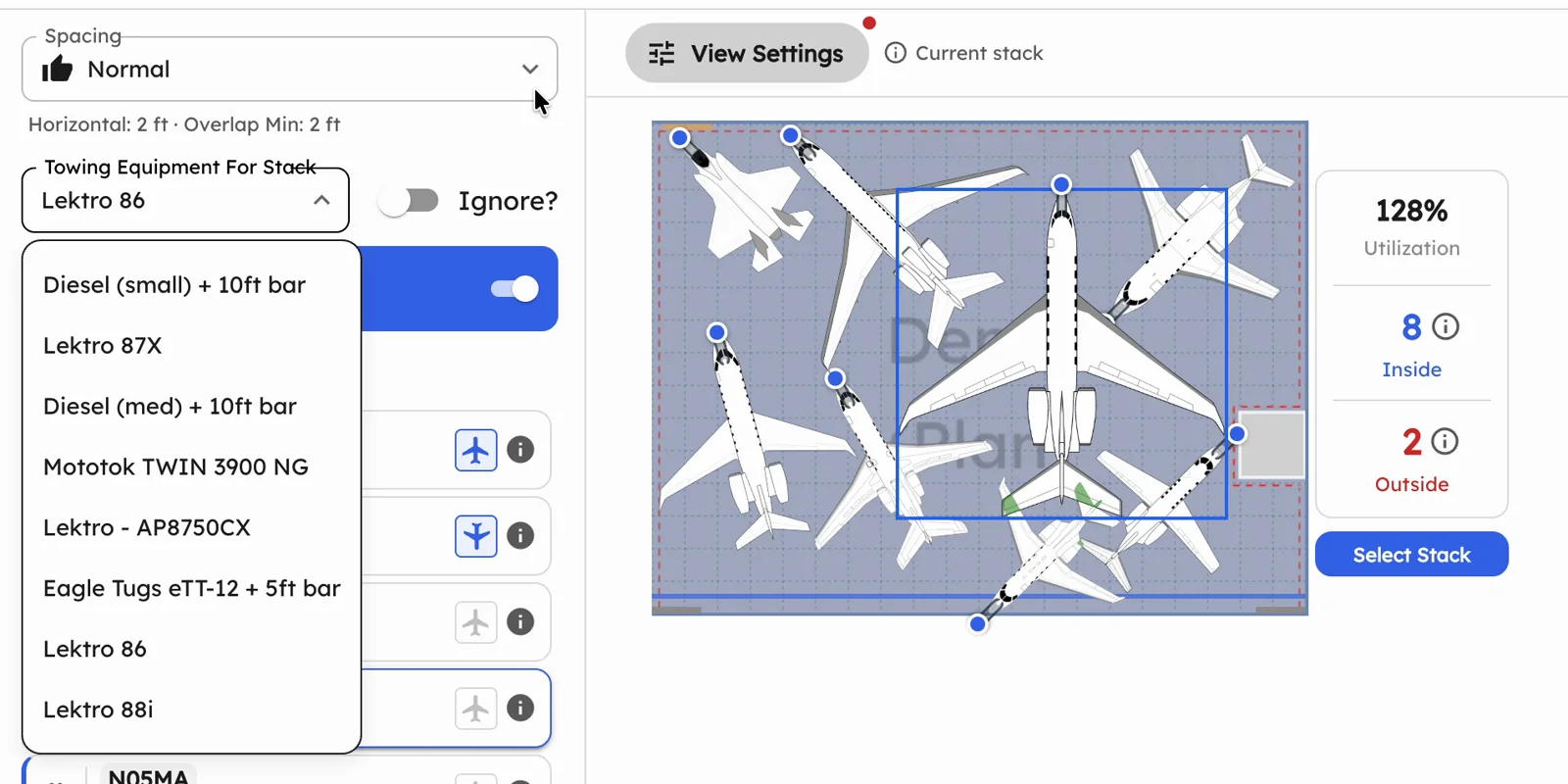
Eight tugs set up for this hangar, out of the 146 real models we added in August. Pick a different one and it rebuilds the layout around how that tug turns. If you want to see how much the tug matters, we stacked the same hangar with three of them.
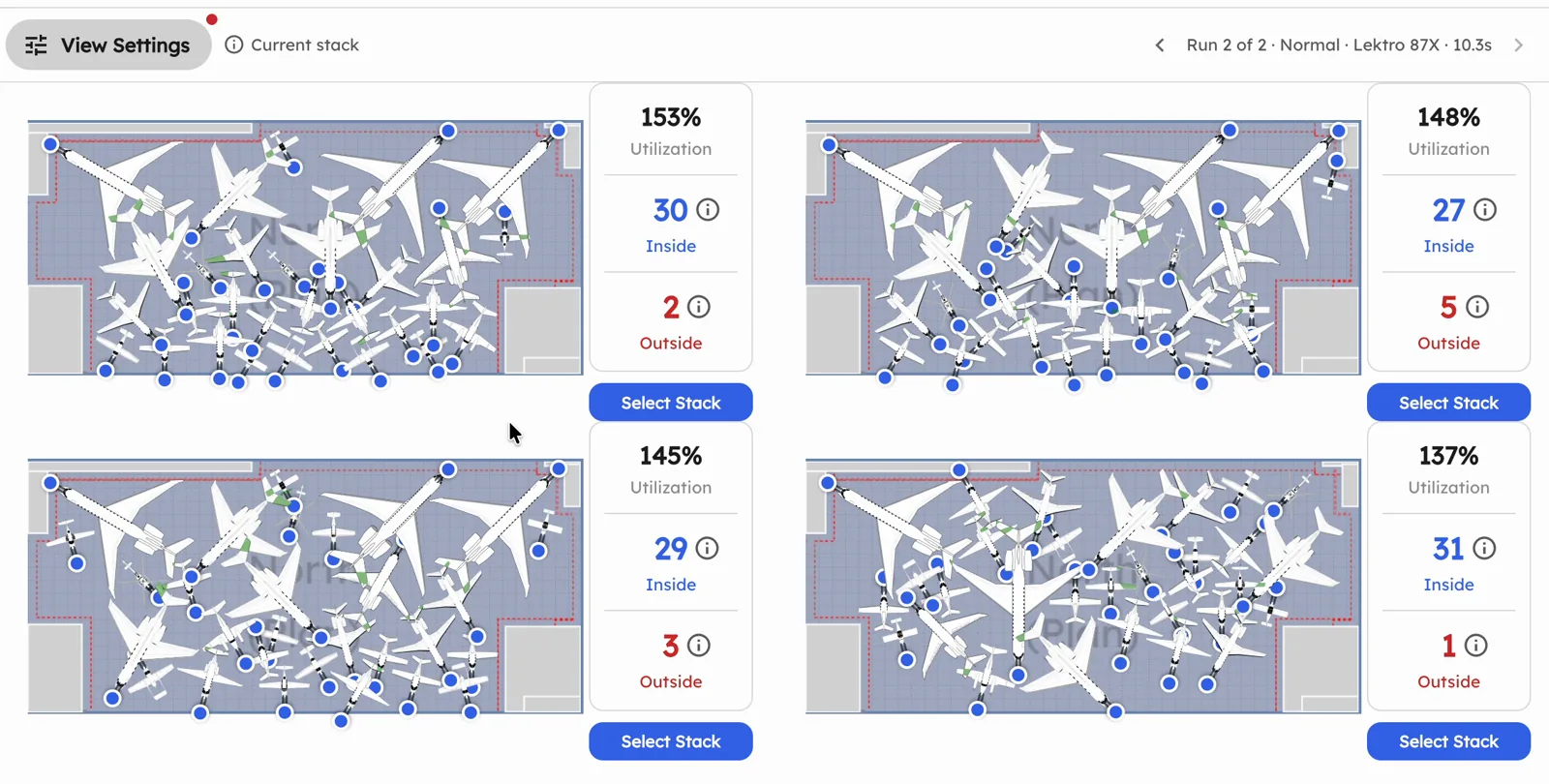
It doesn't hand you one answer. Four layouts for the same 32 aircraft, scored, in 10.3 seconds. Worth noticing that the densest one isn't the one that gets the most aircraft indoors: 153 percent leaves two outside, 137 percent leaves one. That's a real trade and it should be your call, not the algorithm's.
It understands the real world
A lot of times hangars are not a nice clean box. Almost never, in our experience. There's a parts cage in one corner, an office block eating half a wall, a door that isn't centered, and a beam at fourteen feet that only matters to some of your fleet.
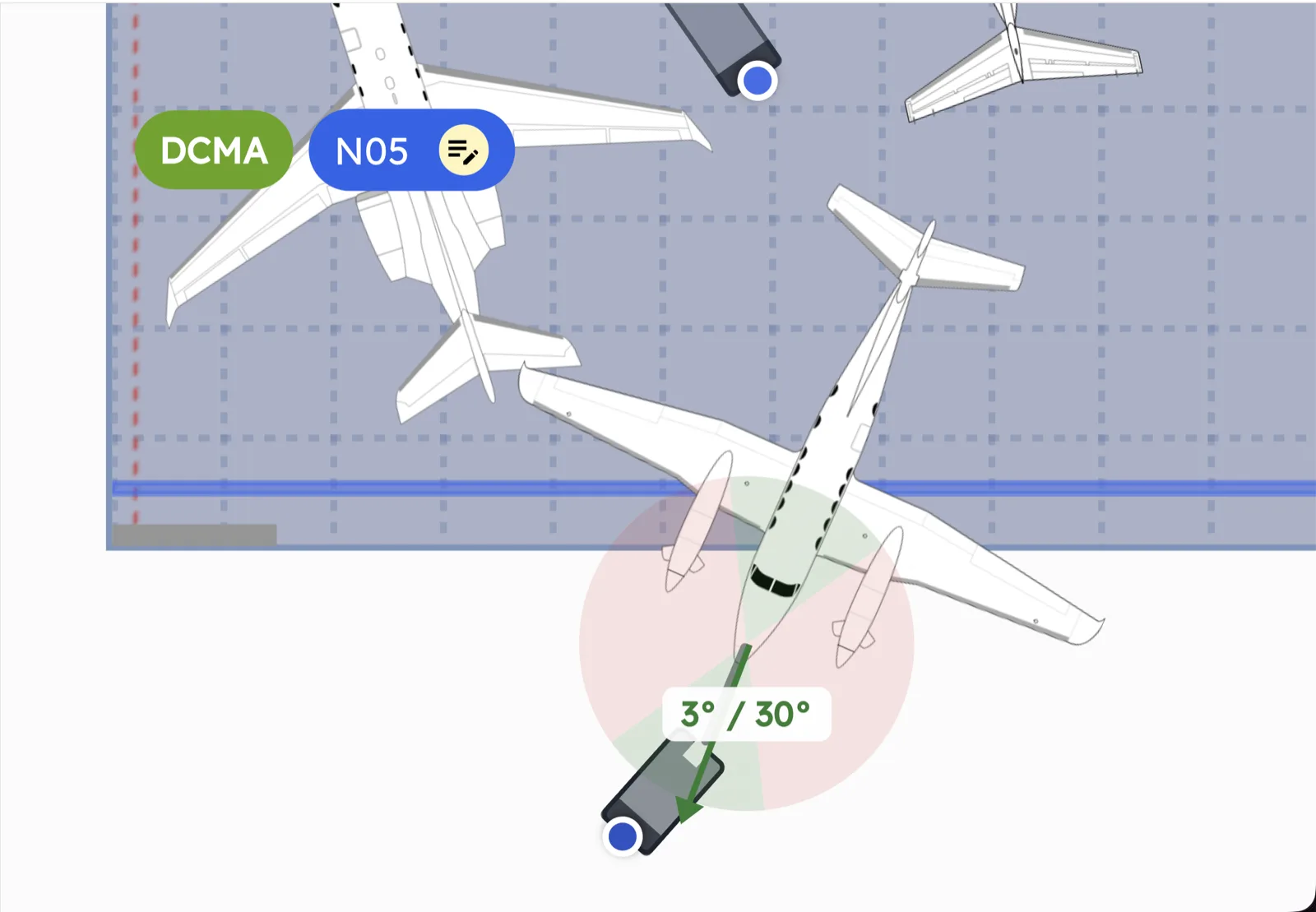
This is where the world model earns its keep. AutoStack 2.0 knows what's in your building and it simulates the towing, so it's planning the tow in and the tow out for every aircraft instead of dropping footprints onto a floor plan. That's the whole test for us: can your team go build the thing it drew.
- Offices, cages and ground obstacles it has to route around
- Overhead obstacles by clearance, so a low beam only blocks what's too tall to fit under
- Multiple doors, used properly, if your building has more than one
- Garage doors, and what they do to the real size of the opening
- Simulated tow paths for every aircraft, in and back out again
- Thirty aircraft in one building, planned in about ten seconds
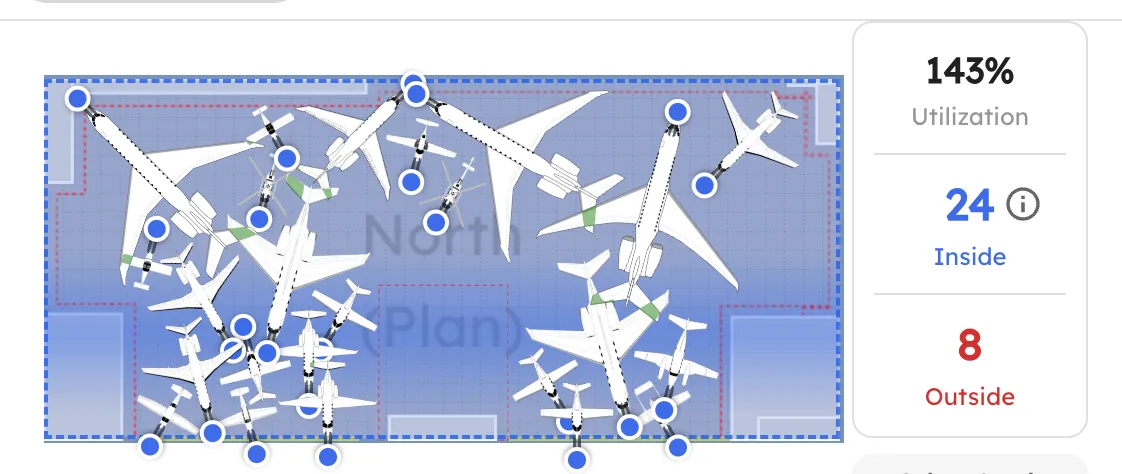
One run at this building: 32 aircraft, 24 of them inside at 143 percent. The 153 percent run further up got 30 of them in. That gap is the part worth arguing about.
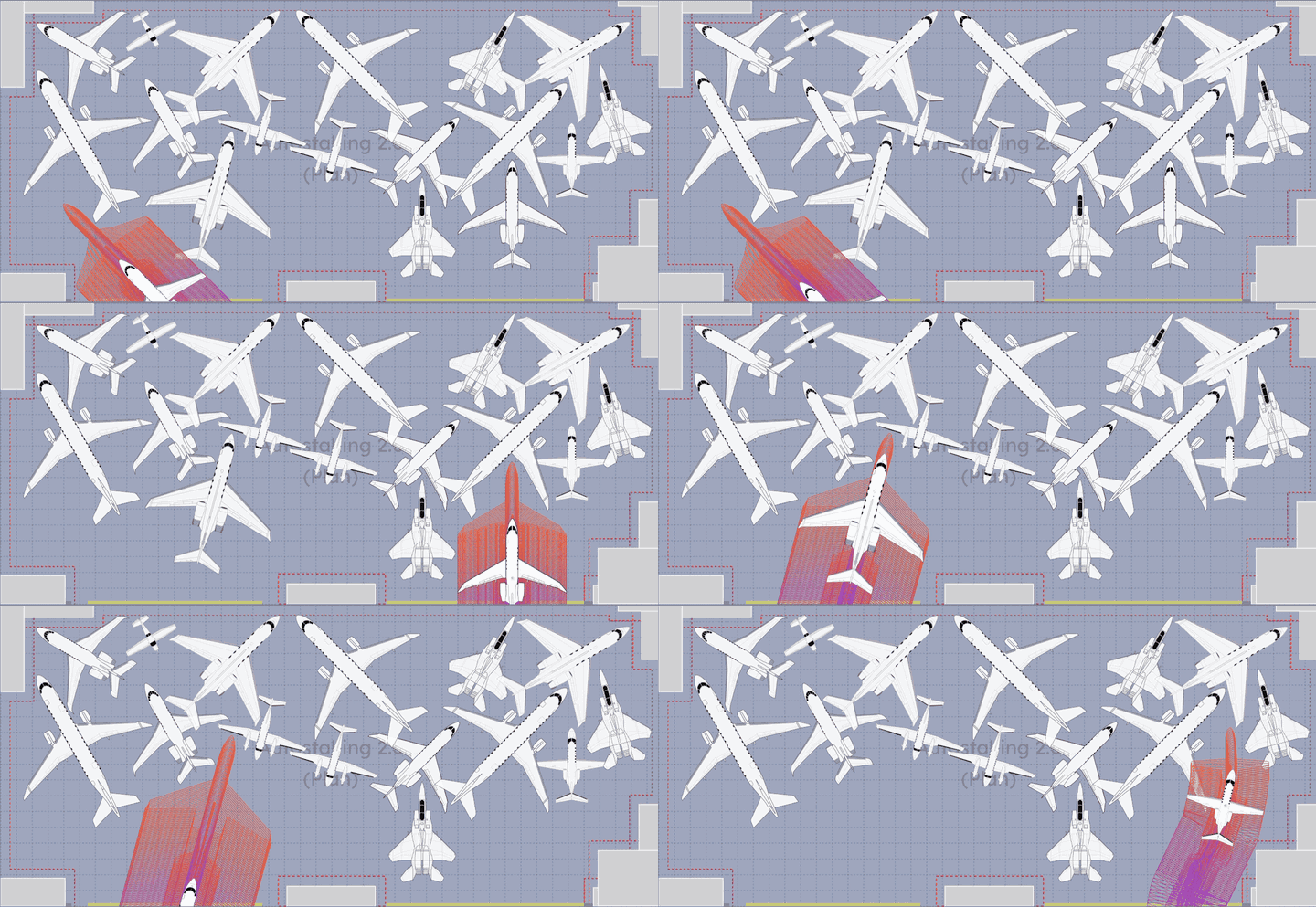
One aircraft coming out of a full building, on the path it would take. Every tow in the plan is simulated like this, in order, so you can scrub all thirty before anybody touches a tug.
Utilization over 100 percent isn't a typo. We measure it as footprint area, wingspan times length, over usable floor. Above 100 percent means those footprints overlap, a wing tucked under a tail, a nose staggered beneath a higher fuselage. That overlap is where the capacity comes from, and it's standard 3D stacking practice.
More accurate towing simulation is what turns into more utilization. If the engine is guessing about how a tug swings through a door, it has to leave slack everywhere to be safe. If it knows, it doesn't.

AirPlx also knows how to use doors. Luckily it won't try to eat you.
It's on for your base today
Open a hangar and hit AutoStack. That's the whole rollout.
Your saved stacking profiles, spacing rules and orientation locks all carried over from 1.0.
As always, the roadmap is shaped by what you tell us. Email us at hi@airplx.com.
Want to see it run on your building? Schedule a quick demo or email us: hi@airplx.com