What Is Aircraft Ground Handling? A Practical Operator's Guide
Published on September 12, 2025 • 6 min read
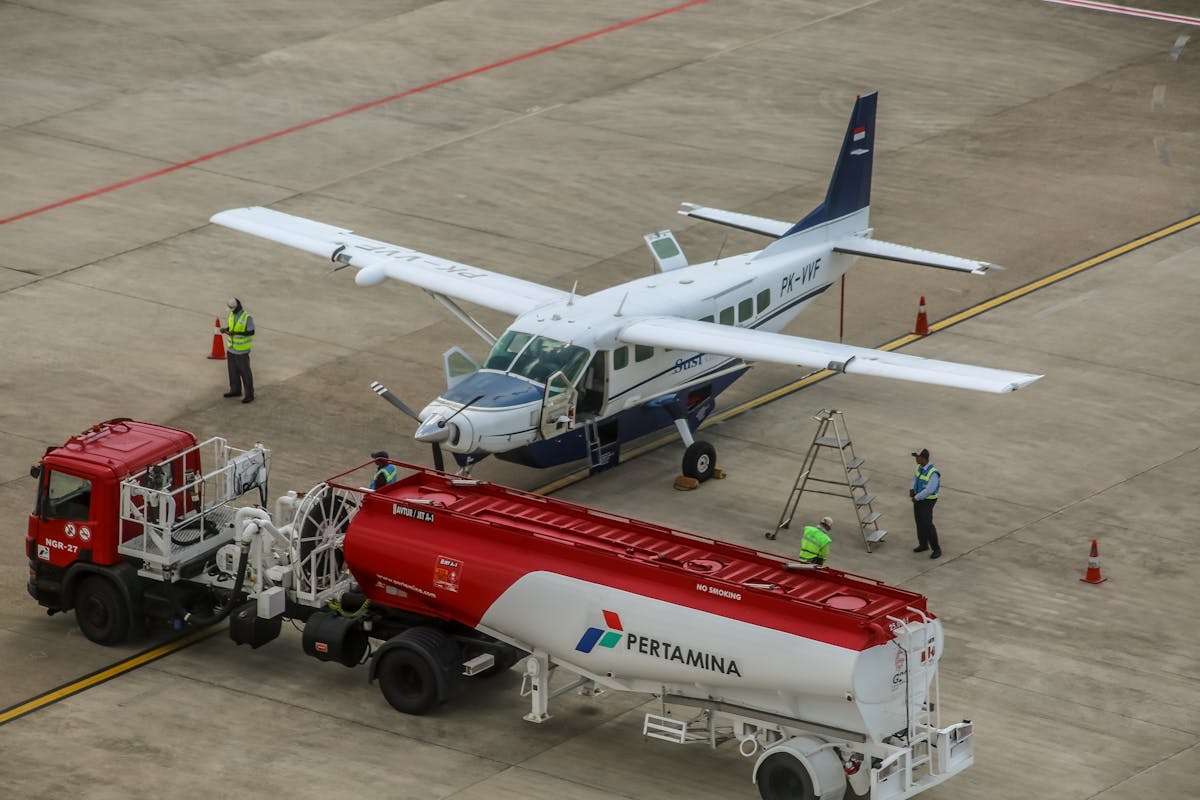
A King Air rolls onto your ramp at 4:47 PM. The pilot wants 280 gallons of Jet-A, GPU while the passengers deplane, a lav service, two cases of bottled water, and a hangar pull for the night because rain is forecast. Your line lead has 12 minutes before the next arrival, a Phenom 300E that called five-mile final, needs a quick turn, and is critical-fuel for the next leg.
That entire choreography is aircraft ground handling. It is the work that happens between block-in and block-out, and it is the single largest variable in whether your FBO ramp runs profitably or runs into the ditch.
What Is Aircraft Ground Handling?
Aircraft ground handling is the set of services performed on an aircraft while it is on the ground, between landing and the next takeoff. It covers everything that touches the airframe (marshaling, towing, chocks, GPU, lav, water, bags) and most of what touches the people (catering coordination, crew transport, customs paperwork at international stations).
At a U.S. FBO, the work is usually called line service when you are talking about the crew, and ground handling when you are talking about the invoice or the contract. Outside the U.S., the two terms split more cleanly because a third-party handler often sits between the FBO and the operator.
This post is the operator's version of the definition. What gets done, who does it, who pays for it, how long it takes, and where it goes wrong.
See how many aircraft fit in your hangar
AirPlx calculates optimized 3D stacking layouts for your exact hangar dimensions.
Run a free layout simulationWhere the Term Comes From
"Ground handling" is borrowed from the airline world. In commercial aviation, ground handling is a regulated, certificated service category that covers ramp ops, passenger services, baggage, cargo, and aircraft servicing. It is bid out to dedicated handlers like Swissport, dnata, Menzies, and Worldwide Flight Services. The International Air Transport Association maintains the Ground Operations Manual (IGOM) that codifies most of the airline-side procedures.
General aviation inherited the vocabulary but flattened the structure. At a typical U.S. FBO, the same crew that marshals the aircraft also drives the fuel truck, hooks up the GPU, services the lav, runs the bags out to the courtesy car, and (later that night) tows the airplane into the hangar. The "handler" is the FBO.
This matters when you read a contract. An international trip handler invoicing your flight department for "ground handling at LFPB" is talking about a different scope than your home FBO's monthly statement. Same words, different scope.
Who Talks to Whom: Line Service, Ramp Control, and FBO Ops
Three jobs sit next to each other on every FBO ramp. Confusing them is the most common rookie mistake.
Line service is hands on the aircraft. Marshaling wands, towbars, GPU cables, fuel nozzles, lav carts. The line tech is the person physically performing the ground handle.
Ramp control is the traffic cop. At a busy FBO leasehold, somebody has to sequence which aircraft moves when, especially in hangar alleys and on the apron between the FBO's ramp and the airport taxiway. At larger fields this is a dedicated radio position with its own frequency. At smaller FBOs it is the line lead with a handheld and a sightline, working off the same ramp and taxiway markings the pilots are reading.
FBO ops is the front-of-house dispatch. They take the call from the pilot or trip planner, post the slot on the board, build the customer profile (catering preferences, hangar requested, ground transport), and hand off to line service when the aircraft is on final.
If any one of those three roles is unclear in your operation, the symptoms show up the same way: missed quick turns, two trucks arriving at the same aircraft, or a passenger waiting in the lobby while their plane sits chocked on the ramp with no one assigned to it.
What Ground Handling Actually Includes
A full ground handle covers some or all of the following, in roughly this order:
| Service | When it happens | Who provides it |
|---|---|---|
| Marshaling and parking | On block-in | Line service |
| Chocks and cones | Immediately after marshaling | Line service |
| GPU / PCA hookup | Before engine shutdown if requested | Line service |
| Passenger and crew deplane | After chocks set | Line service + FBO ops |
| Baggage offload | With or after passengers | Line service |
| Lavatory service | On request, usually mid-turn | Line service |
| Potable water service | On request | Line service |
| Fueling | Most of the turn time | Line service (FBO-owned fuel) |
| Catering offload / onload | Coordinated by FBO ops, delivered by caterer | Caterer + FBO ops |
| Crew transport / hotel coordination | On request | FBO ops |
| Customs / GenDec processing | At international stations | FBO ops |
| Pushback or tow | On block-out, or to hangar | Line service |
| Hangar stage and tow | Between flights, usually overnight | Line service |
Not every turn gets every line item. A quick-turn Phenom 300E with a single pax and no bags is GPU, fuel, chocks-out, and gone. An overnight Gulfstream G650 stops by every line on this list, plus a wash and a vacuum if the owner is based there.
Who Pays for What
Ground handling is one of the few corners of FBO economics where the customer pays in three different currencies at once: fuel margin, ramp fees, and itemized service fees. Understanding the mix is half of running the business.
Ramp / facility fee. The lump-sum charge for landing and parking on the FBO ramp. Most FBOs waive this with a minimum fuel uplift (usually 50 to 200 gallons depending on aircraft class). The fee itself ranges from roughly $50 at a small GA field to $500+ at major metro FBOs for heavy jets. This is what most operators mean when they grumble about "handling fees" at a U.S. FBO.
Bundled line service. Marshaling, chocks, one GPU hookup, ramp pickup of the pilot. At a U.S. FBO this is almost always included in the ramp fee or waived with fuel. The line crew does not write a separate ticket for it.
Itemized services. Lav, potable water, hangar tow, overnight RON storage, de-icing, ground transport, conference room. These are line items. Lav is commonly $35 to $75, with metro FBOs charging up to $100. Hangar overnight runs around $0.12 per square foot at regional fields and $0.50 to $2.00 per square foot at major metro FBOs, sometimes flat-rate by class. De-icing is by the gallon of fluid plus a setup fee.
Fuel. The big lever. A 300-gallon Jet-A uplift at a $1.50/gallon margin is $450 of FBO contribution, and it is the lever that decides whether the ramp fee gets waived. The whole bundling logic of U.S. FBO pricing is built around steering operators toward enough fuel volume to justify the rest of the handle.
International ground handling unbundles all of this. Fuel is contracted with a separate supplier (often Avfuel, World Kinect (formerly World Fuel Services), Air bp, Shell, or local). The handler invoices line by line: ramp, GPU, lav, stairs, marshaling, bag handling, security escort. Trip-support providers — Universal, Jeppesen, Jetex, UAS, and World Kinect (which now owns Colt International and is acquiring Universal's trip-support business) — consolidate the invoice but do not change the structure.
How Long Does a Ground Handle Actually Take?
These are operator-side benchmarks from how the work runs at a well-staffed FBO. Treat them as ranges, not promises. Weather, ramp congestion, catering delays, and customs at international stations all push the upper end higher.
| Aircraft class | Quick-turn time (block-in to block-out) | Full-service turn | Typical fuel uplift | GPU minutes |
|---|---|---|---|---|
| Light jet (CJ4, Phenom 300E) | 25-45 min | 45-75 min | 200-500 gal | 15-40 |
| Midsize (XLS+, Latitude) | 35-55 min | 60-90 min | 400-900 gal | 20-50 |
| Super-midsize (Challenger 350) | 45-65 min | 75-110 min | 700-1,300 gal | 25-60 |
| Heavy (G650, Global 7500) | 60-90 min | 90-150 min | 1,500-3,500 gal | 30-90 |
| Turboprop (King Air, PC-12) | 20-40 min | 35-60 min | 100-300 gal | 10-30 |
A "quick turn" assumes no catering, no lav, no hangar pull, passengers staying with the aircraft or going directly to a waiting car. A "full-service" turn includes all of those plus a wash-the-windshield handshake from the FBO lead.
The fuel-uplift bands are wide on purpose. A heavy jet repositioning empty to its next pickup might take 800 gallons. The same airframe on a transcontinental tankering plan might take 3,500. Both are normal.
Where Ground Handling Goes Wrong
The work is mostly routine. The exceptions are expensive. The recurring failure modes show up in NTSB and FAA ramp incident data almost every year. The Flight Safety Foundation's Ground Accident Prevention program estimated ramp accidents cost commercial airlines roughly $10 billion annually, and IATA projects industry-wide ground damage costs could reach that level by 2035 without better procedures and GSE. Business aviation is a smaller slice — an oft-cited NBAA estimate put North American business-aircraft ground damage near $100 million per year — but the failure modes are the same:
FOD events. A dropped tool, a loose chock, or a piece of pavement debris ingested into an engine on startup. Single-incident repair costs on a turbofan FOD strike start in the high five figures and climb fast.
Wingtip and tail strikes during tow. The single largest source of FBO insurance claims. Wing-sweep math is non-intuitive, especially on aircraft like the Falcon 900 family where the wing's geometry surprises crews trained on straighter airframes. A scuffed wingtip cap on a Falcon can run $20,000 to $50,000; a structural wingtip or control-surface strike on a heavy jet routinely lands in the $250,000 to $500,000 range. Industry-wide average claim severity is far lower, but FBO insurance experience skews high because the airframes are expensive.
Hot brakes after a short rejected takeoff or a steep arrival. A King Air or light jet that brakes hard on landing can park with brake temperatures well above the placard cool-down threshold. Approaching with the chocks before the brakes cool is how line techs get hurt and how brake-fire incidents start.
Fueling-side incidents. Static discharge, fuel-truck contact, wrong-fuel uplifts (Jet-A into a piston aircraft is the classic, and it still happens). The bonding-and-grounding step on the checklist exists because the alternative is a fire.
Prop strikes during pushback or hand-tow. Propeller-equipped aircraft on a crowded hangar floor with a hand tow are a routine source of close calls. A single prop strike incident can ground the aircraft for weeks and trigger a teardown inspection on the engine.
Most of these failure modes share a root cause: an undertrained or overworked line crew, working faster than the SOP allows because the next aircraft is on final. The fix is not slogans. It is staffing levels, training hours, and a ramp culture that lets a tech stop the move when something is off. The FBOs we work with that have the lowest incident rates almost always have the highest line-tech retention.
International vs. U.S.
A few practical differences worth knowing if you are a U.S.-based flight department flying abroad:
- Mandatory handler. Most international airports require a licensed ground handler. You cannot self-handle a Gulfstream at LFPB the way you can at most U.S. fields.
- Fuel separate from handling. The fuel uplift is its own invoice, with its own taxes (VAT in Europe), and is rarely bundled with the ramp fee.
- Slot coordination. Many European and Asian stations are slot-controlled. Your handler arranges the arrival/departure slot, which is a real cost line.
- Crew transport, security, and customs. Routinely itemized abroad. At most U.S. FBOs they are courtesy services or low-cost add-ons.
If your operation is mostly domestic, the international invoice is a useful exercise in unbundling. It shows you what your home FBO is actually giving away when it waives the ramp fee on a 200-gallon uplift.
When an FBO Outsources Handling vs. Keeps It In-House
The default for U.S. FBOs is to handle in-house. Line service is the main customer-facing surface area, and outsourcing it means giving up control of the brand experience.
The exceptions cluster in three places:
- International or military contract stations. Where the handler license is the gating constraint.
- Overflow events. NBAA-BACE, Super Bowl weekends, the World Cup. The home crew handles the regulars. A contract crew fills the surge.
- Multi-tenant fields. A single line-service company handles all the sub-tenants on a shared leasehold, with each tenant paying a per-aircraft fee. Common at small fields with two or three FBO operators on the same apron.
The math on in-house vs. contract turns on three numbers: line-tech fully loaded cost (wages + benefits + training + uniforms), per-turn revenue from the customers you handle, and the opportunity cost of a senior tech doing routine work that a junior tech could cover. We have seen good FBOs run both models in the same year, in-house most days and contract during a known surge week.
Why It Matters for the Hangar
The reason ground handling sits inside this blog (and not on an aviation-trade publication) is that it is the upstream input to every other FBO operations decision.
A line crew that runs efficient turns frees up ramp space. Ramp space that turns over fast gets more transient revenue. Transient revenue funds the labor for staging and stacking the hangar overnight. A well-stacked hangar pulls more based tenants and more RON traffic, which makes the next day's line plan easier.
Conversely, a line crew that drops behind on turns produces ramp congestion, missed hangar stages, and at the worst end, the incident that flips a quarter's P&L. Ground handling is not a back-office function. It is the operations engine that the rest of the FBO sits on top of.
If you are an FBO GM and you have not looked at your line crew's turn-time distribution lately, that is the first place to find capacity you did not know you had. The second place is the revenue mix on the ramp itself. The third is what happens to your hangar floor when the line crew goes home.
The definition is the easy part. The discipline is in the choreography — and increasingly, in the aircraft ground handling software that lets a crew plan the sequence before they execute it.