How Full Is Your FBO Ramp? Measuring Capacity in OCU
Published on June 15, 2026 • 4 min read
A Global 7500 calls 10 miles out. Your line lead keys up and asks the one question that runs every FBO ramp: "Do we have room?"
The honest answer is usually a shrug. The ramp "feels full." But "feels full" is not a number you can plan a shift around, and "we're at 74% of the slab" tells you almost nothing about whether one more Global 7500 actually fits.
So we built a simpler unit of measurement, and a free calculator that does the math. This is the short version of how it works.
The problem with square footage
Your ramp has a size. That number is on the lease. On its own, it is a poor guide for parking decisions.
Obviously it depends. A long, narrow apron parks nothing like a square one, your tow paths and tie-down grid matter, and a sharp crew squeezes more out of the same slab than a tired one. No single number replaces a planner who knows the ramp. But as a baseline, raw area still oversells what you can actually use, and it gives a line lead nothing to act on when a jet is on final.
Usable parking is always smaller than total area. You lose space to taxi lanes, vehicle roads, ground support equipment staging, and wingtip-to-wingtip safety clearance between aircraft. FAA airport design standards spell out minimum wingtip clearances between parked aircraft for exactly this reason (AC 150/5300-13B, Airport Design). A good planning rule of thumb: count on roughly 55% of your theoretical max being actually usable.
So a "100,000 square foot ramp" is really more like 55,000 working square feet. And "we're 74% full" still does not tell your line crew whether the next jet fits. Nobody can picture a percentage of a slab.
See how many aircraft fit in your hangar
AirPlx calculates optimized 3D stacking layouts for your exact hangar dimensions.
Run a free layout simulationWhat an OCU is
The Economist's Big Mac Index measures something genuinely hard, the purchasing power of a currency, by pricing one familiar thing that exists almost everywhere: a Big Mac. A burger is not a serious unit of macroeconomics, but it is intuitive, consistent, and instantly comparable across the dozens of countries that have one.

The Big Mac Index turns "what is this currency worth?" into one comparable number per country. OCU does the same trick for ramp space, with the Challenger 300 standing in for the burger. (Map: The Economist Big Mac Index, 2022.)
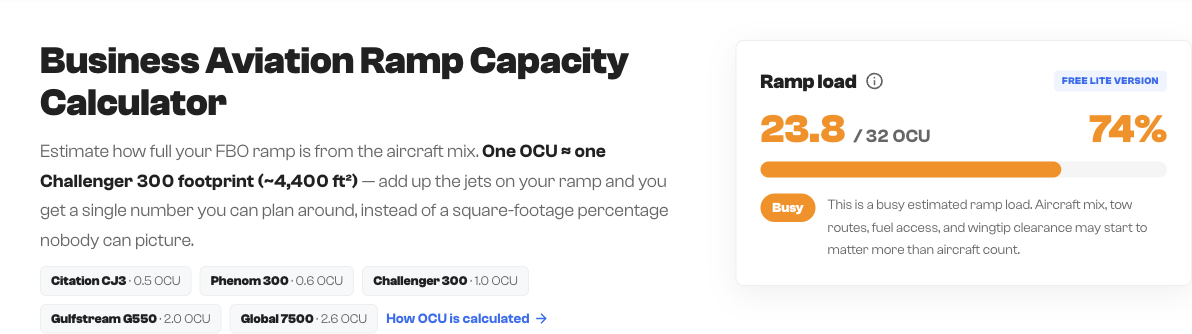
OCU borrows that idea. Instead of comparing abstract square footage, you price every aircraft against one familiar reference jet. One Operational Capacity Unit (OCU) equals one Challenger 300 footprint: about 4,400 square feet, including the working space around the aircraft.
Every other aircraft is scored against that benchmark. The underlying idea is roughly wingspan times length over 4,400, so footprint scales continuously instead of forcing jets into rigid size buckets (AirPlx docs). This lite tool then ships rounded, generic OCU values per type, which gives every aircraft a single, plannable number:
- Citation CJ3: 0.5 OCU
- Phenom 300: 0.6 OCU
- Challenger 300: 1.0 OCU
- Gulfstream G550: 2.0 OCU
- Global 7500: 2.6 OCU
Add up the jets on your ramp and you get one number you can actually plan around, instead of a percentage nobody can picture.
One OCU equals one Challenger 300 footprint. The result card turns your aircraft mix into a single number you can plan around.
This isn't a new idea. It is how the most demanding ramp in the world already works. The US Navy scores every carrier aircraft against a single reference jet: the F/A-18C Hornet sits at a "spot factor" of 1.0, and everything else is priced up or down from there to plan how many airframes fit on a flight deck or hangar deck. The Navy has even funded automated tools to generate those spot factors and pack decks at maximum density (Navy SBIR N082-125, Automated Maximum Density Analysis Tool for Spot Factor Generation). OCU is the same move for business aviation, with the Challenger 300 standing in for the Hornet.

The Navy plays the same game on a carrier deck: every aircraft scored against a reference jet, then packed at maximum density. (U.S. Navy photo.)
How to read the number
Enter your aircraft mix and the tool sums quantity times OCU per row. The example below is a busy mixed ramp: three Global 7500s, three G550s, four Challenger 300s, four King Air 350s, and five Citation XLS jets.
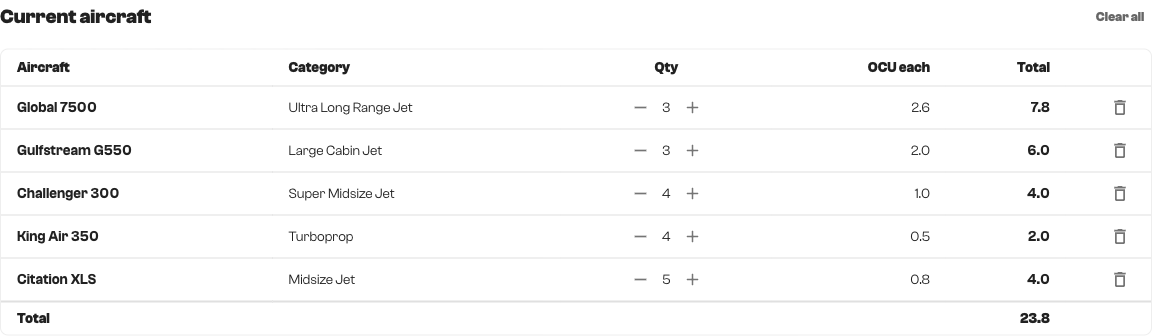
Three Global 7500s alone eat 7.8 OCU. Five light Citation XLS jets add up to just 4.0. Mix matters more than headcount.
Notice the lesson hiding in that table. Three Global 7500s consume 7.8 OCU. Five Citation XLS jets consume 4.0. Aircraft count is a bad proxy for how full you are. Mix is what fills a ramp.
Comfortable, busy, or at capacity
Set your ramp capacity (in OCU) and the tool grades the load:
- Under 70%: comfortable. Room for transient traffic.
- 70 to 90%: busy. Tow routes, fuel access, and wingtip clearance start to matter more than count.
- Over 90%: at capacity. Adding a large-cabin or ultra-long-range jet likely means overflow parking or active repositioning.
That last band is not theoretical. During peak weeks like NBAA-BACE or the FIFA World Cup, busy airports run special event parking programs precisely because demand blows past the slab (NBAA). The same 32-OCU ramp that runs comfortable on a Tuesday goes deep red when the transient jets pile in.
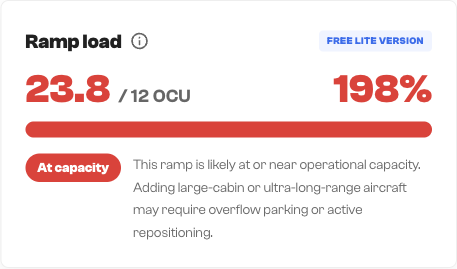
The same 23.8 OCU of aircraft on a 12-OCU small ramp: 198% and well past capacity. The number tells you to plan overflow before the jets arrive, not after.
Try it on your own ramp
Pick a preset (Small 12, Medium 24, or Large 40 OCU) or type your own, plug in your aircraft mix, and you have a quick read you can hand to a line lead before the next arrival calls final.
Open the free Business Aviation Ramp Capacity Calculator →
One honest caveat: this is a planning estimate, not an exact parking plan. The free version covers common business aircraft with generic OCU values, so it answers "are we getting tight?" not "does tail N123AB fit in spot 4." When you want capacity planned on your exact layout, with tow routes, wingtip clearances, tenant rules, and per-tail dimensions down to the N-number for 1,000+ aircraft, that is what our ramp planning software and hangar stacking software are built to do. Book a demo if you want to see your own ramp run.