Aviation Industry Trends 2026: The $10 Billion Hangar Problem
Published on April 7, 2025 • 5 min read
Ground damage already costs airlines billions every year, and IATA's 2024 ground damage study warns the annual bill could approach $10 billion by 2035 without intervention. At the same time, 71% of general aviation airports report critical hangar shortages, with waitlists exceeding 70 pilots at some locations.
These problems are connected. Poor hangar management leads to rushed aircraft movements, cramped conditions, and expensive mistakes. Managing million-dollar jets in tight quarters inevitably leads to costly incidents.
Why 2026 Is Hangar Management's Breaking Point
The data reveals a stark reality. General aviation is still in a multi-year growth cycle—the student pilot population has nearly doubled since 2020. Honeywell's 2025 Global Business Aviation Outlook forecasts 8,500 new business jets worth $283 billion will be delivered over the next decade, with 2026 deliveries projected to run 5% above 2025. 20% of operators globally now have at least one aircraft on firm order, up from 17% a year earlier. Yet hangar construction costs have more than doubled in 20 years, now reaching $60-$120 per square foot.
One FBO manager in Oregon captured the frustration perfectly: "We have 35 pilots on our waitlist. Some have been waiting for years, and they're actually going backwards as new customers jump the line." Meanwhile, IATA's 2025 safety report flagged ground damage as one of the most common incident categories of the year, alongside tail strikes and landing gear events—each one a multi-million dollar repair waiting to happen.
Planning for the next generation of aircraft?
AirPlx includes 1,000+ aircraft models with verified dimensions. Stack your hangar before the aircraft arrives.
See AutoStack in actionThe Real Cost of Bad Hangar Management
Consider the financial impact that concerns FBO managers:
- Lost Revenue: With hangars renting at $0.40-0.70 per sq ft monthly, a poorly optimized 15,000 sq ft hangar loses $30,000+ yearly in potential income
- Ground Damage: Ground operations cause 11% of aircraft damage—one mishap can cost millions
- Customer Churn: "Arrived, reiterated our confirmed hangarage... next morning the plane was parked outside, soaking wet from overnight thunderstorm"—actual pilot quote
- Workforce Issues: "Ramp workers are all transient," leading to inconsistent service and increased damage risk
Three Game-Changing Trends Solving the Crisis
1. 3D Optimization Algorithms Now Deliver Results
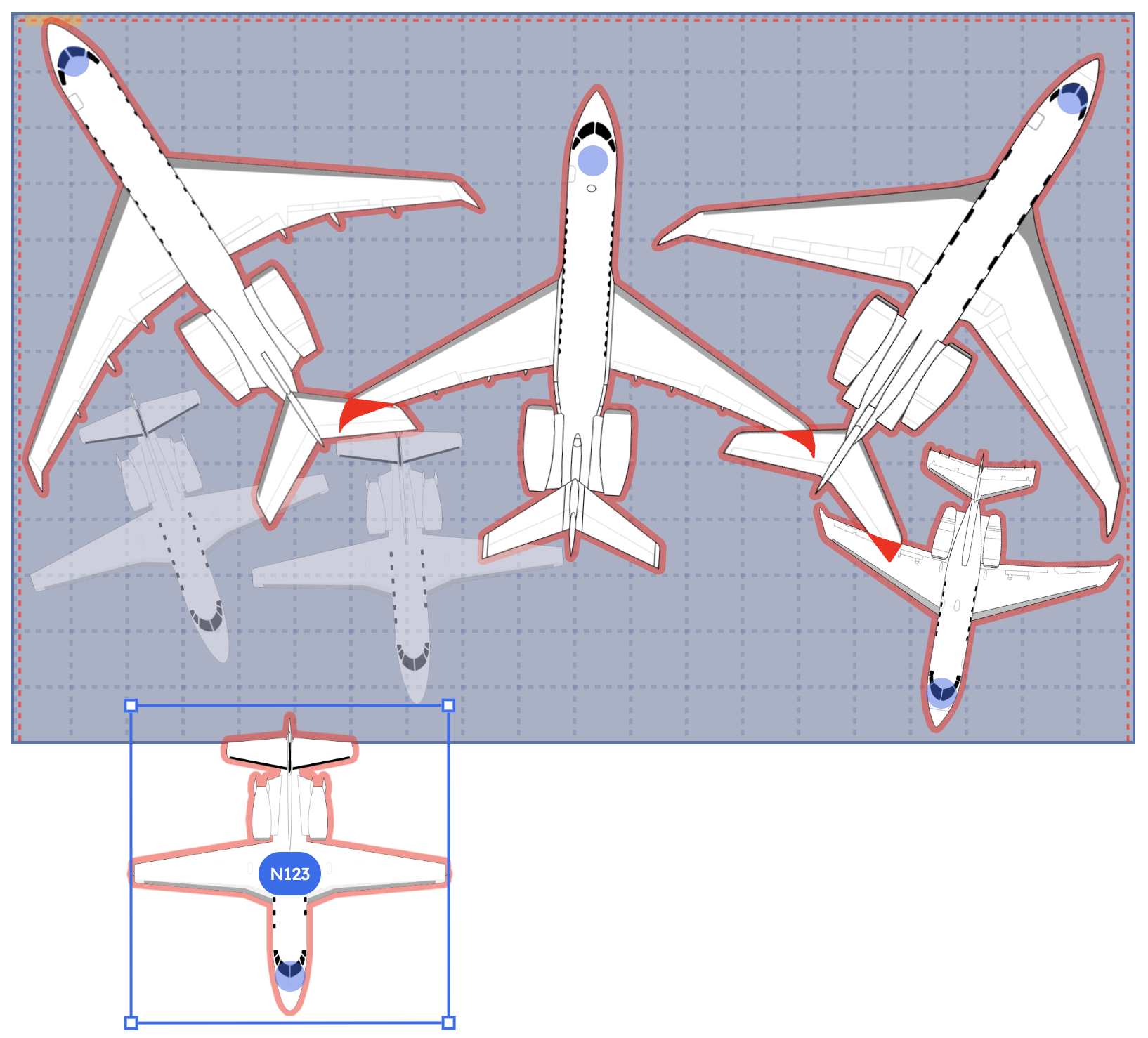
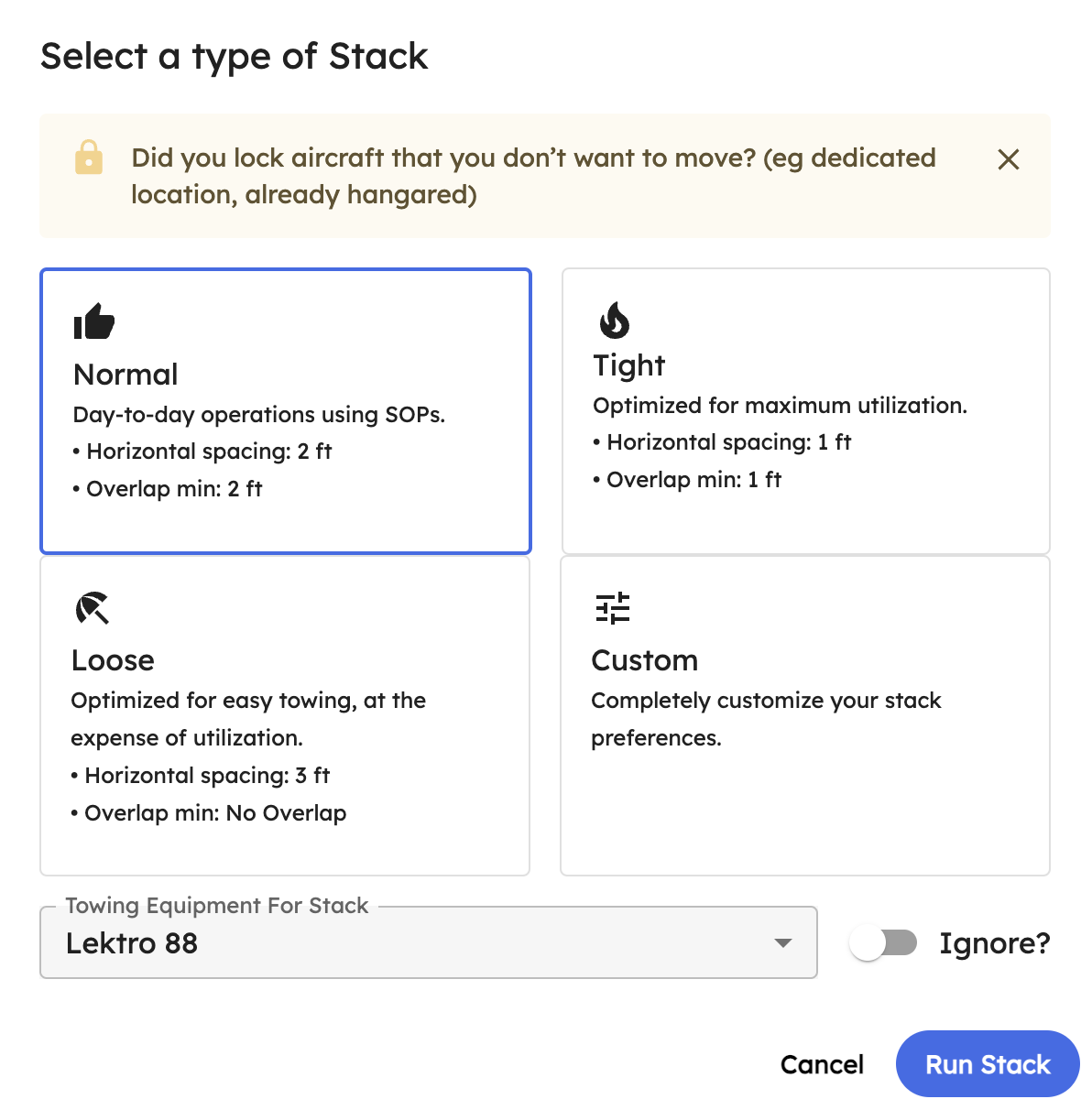
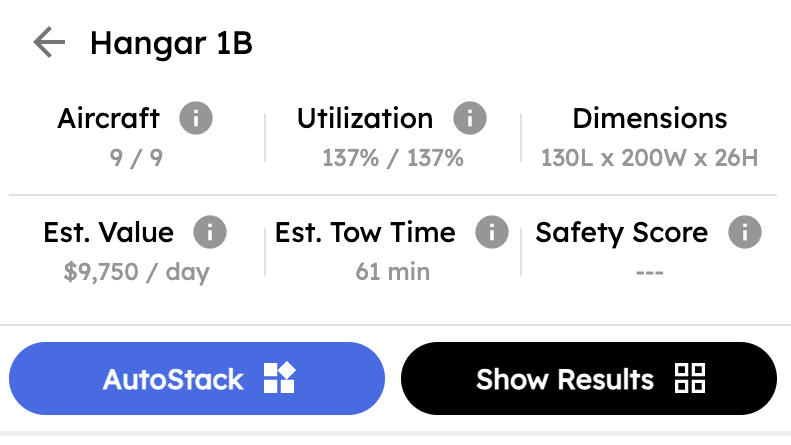
The era of managing hangars with spreadsheets and guesswork has ended. Modern AI processes aircraft dimensions, turning radii, and towing constraints in real-time. One FBO using advanced 3D stacking optimization increased capacity by 40% without adding a single square foot.
These systems think in three dimensions, considering wingtip clearances, tail heights, and seasonal traffic patterns. They solve the complex spatial puzzle that human planning simply can't optimize.
What it looks like on the ramp: FBOs that have adopted 3D optimization consistently report the same pattern—line crews spend a few minutes generating a stacking plan instead of a long pre-shift huddle, and towing sequences are sequenced to avoid the peak-departure bottlenecks that used to back up the ramp every morning.
Implementation reality check: The transition isn't instant. Most FBOs need 2-3 weeks for staff training and system integration. Initial setup costs range from $15,000-$50,000 depending on hangar size, but payback typically occurs within 6-8 months through increased capacity utilization.
2. Digital Twins Prevent Million-Dollar Mistakes
Digital twin technology now lets FBOs simulate every aircraft movement before it happens. Test new layouts, train staff, and identify collision risks—all virtually. Given how often ground damage shows up near the top of IATA's 2025 incident categories, the case for simulating moves before doing them is hard to argue with.
What we're seeing in the field: Operations that pair a digital twin with a structured onboarding program let new line crew members practice in a virtual environment before touching real jets. The "what if" scenarios—pulling a Global out from behind two Citations, repositioning for an unexpected hot turn—become muscle memory without the risk of a multi-million dollar miscalculation.
The implementation challenge: Digital twins require accurate hangar mapping and ongoing calibration. Initial setup takes 4-6 weeks and costs $25,000-$75,000. Staff need 40+ hours of training to use the system effectively. However, the technology pays for itself by preventing just one significant incident.
The return on investment is compelling: preventing just one ground incident pays for the technology many times over.
3. Integrated Cloud Platforms
Most FBOs still manage operations with "nothing more than a Rent Roll spreadsheet and a DropBox," according to industry reports. Cloud-based platforms are transforming operations by integrating:
- Real-time space optimization with billing systems
- Towing schedules with collision prevention alerts
- Weather data with automated aircraft shuffling
- Maintenance schedules with space allocation
Weather-driven repositioning, in practice: The most useful integrations we've seen tie hangar assignments to the weather feed. When a line of thunderstorms or an unexpected cold front rolls in, the system flags which aircraft should be pulled inside first based on value, customer SLA, and dwell time—turning a frantic 2 a.m. phone tree into a pre-staged plan.
The hidden costs: Cloud platform integration typically requires 3-6 months of implementation time, staff training for all shifts, and ongoing subscription costs of $500-$2,000 monthly. Legacy system data migration can be complex, often requiring manual cleanup of years of inconsistent records. However, the operational efficiency gains typically justify costs within the first year.
Common Pitfalls to Avoid:
- Underestimating staff training time (budget 60+ hours per employee)
- Inadequate internet infrastructure (requires dedicated high-speed connections)
- Resistance to change from experienced line crew (plan for gradual rollout)
- Integration challenges with existing fuel systems and billing software
Implementation Guide: From Evaluation to Go-Live
Vendor Evaluation Framework
Financial Stability Assessment:
- Minimum 5 years in aviation software market
- Client references from similar-sized FBOs
- Clear upgrade path and long-term development roadmap
- Transparent pricing with no hidden integration fees
Technical Due Diligence:
- API compatibility with existing systems (fuel, billing, scheduling)
- Data security compliance (SOC 2, cybersecurity insurance)
- Disaster recovery and backup procedures
- Mobile app functionality for line crew
Operational Fit Analysis:
- Customization capability for unique hangar configurations
- Staff training requirements and ongoing support structure
- Integration timeline that works with seasonal operations
- Scalability to handle growth and additional locations
90-Day Implementation Timeline
Days 1-30: Foundation Phase
- Complete system setup and data migration
- Hangar mapping and aircraft specification input
- IT infrastructure upgrades (network, hardware, security)
- Initial supervisor training and certification
Days 31-60: Training and Testing
- All-hands training sessions for line crew
- Parallel operation with existing processes
- Daily performance monitoring and adjustment
- Standard operating procedure development
Days 61-90: Full Deployment
- Complete transition to new system
- Performance optimization based on real-world data
- Staff feedback integration and process refinement
- Success metrics establishment and reporting
Success Metrics to Track
Operational Efficiency:
- Aircraft movement time reduction (target: 30% improvement)
- Hangar utilization increase (target: 25% capacity improvement)
- Ground incident reduction (target: 50% fewer incidents)
- Customer satisfaction scores (target: 15% increase)
Financial Performance:
- Revenue per square foot improvement
- Customer retention rate increase
- Operational cost reduction
- Return on investment timeline
The Reality Check: What Technology Can't Fix (Yet)
Before you start shopping for hangar management software, understand the limitations. These systems excel at optimizing space and preventing collisions, but they can't solve every operational challenge:
Labor shortage impact: Even the smartest algorithm can't work with understaffed operations. When you're short two line crew members during peak season, the best software in the world can't move aircraft by itself—it can only sequence the moves your team has time to execute. Learn more about FBO staffing challenges.
Staffing Solutions That Work:
- Cross-training programs: Train customer service staff in basic line operations
- Seasonal partnerships: Share resources with nearby FBOs during peak periods
- Technology-assisted training: Use simulation for faster new employee onboarding
- Predictive scheduling: Use historical data to optimize staffing patterns
Weather Still Wins: Severe weather events can disrupt even the most sophisticated systems. Ice storms, wind shear, and unexpected maintenance issues require human judgment that technology supplements but can't replace. Prepare your FBO for hurricane season with comprehensive planning.
Emergency protocol integration: Modern systems now include severe weather modules that automatically generate emergency evacuation sequences when tornado warnings or hurricane advisories trigger. The good ones consider aircraft value, fuel load, and evacuation time to prioritize which aircraft get hangar protection first—exactly the calculation a stressed-out ops manager doesn't want to be doing at 11 p.m.
Change management hurdles: The biggest barrier isn't technical—it's cultural. As one FBO manager put it: "Our crew had been doing things the same way for 15 years. Getting them to trust a computer system to tell them where to park aircraft was the hardest part of implementation."
Proven Change Management Strategies:
- Champion identification: Select respected crew members as early adopters
- Gradual rollout: Start with less critical operations before peak periods
- Success celebration: Publicly recognize efficiency improvements and safety wins
- Feedback incorporation: Adjust system parameters based on crew recommendations
ROI Timeline Reality: While the technology pays for itself, expect 12-18 months for full ROI realization. Initial productivity may actually decrease during the learning curve period.
Your Strategic Options in 2026
The general aviation industry supports 1.3 million U.S. jobs and generates $339 billion in economic output. Recent market analyses peg the global FBO market between $25-$35 billion in 2026, with most forecasts projecting it to roughly double over the next decade. However, this growth faces a significant constraint: physical space.
With 71% of airports facing hangar shortages and construction costs skyrocketing, the winners won't be those who build more—they'll be those who optimize what they have. The choice is straightforward:
- Option A: Build a new 15,000 sq ft hangar for $1.8 million (if you can find land and permits)
- Option B: Optimize your existing hangar to fit 40% more aircraft for a fraction of the cost
Explore the ROI of hangar stacking automation to understand the financial impact of optimization.
Smart FBOs are choosing optimization. They're converting waitlists into revenue, preventing costly accidents, and fulfilling their hangar commitments.
Maximize Your Hangar Revenue
AirPlx's AutoStack provides proven technology that FBOs use to fit more aircraft, prevent costly damage, and convert waitlists into revenue. Our 3D optimization algorithms consider every constraint: turning radii, wingtip clearances, seasonal patterns, and your specific towing equipment.
Potential impact: A typical 15,000 sq ft hangar optimized with AirPlx can generate an additional $180,000-$300,000 annually.