We Built a Free Private Aviation Event Calendar for FBO Operators
Published on April 17, 2026 • 3 min read
This is the announcement post. The tool lives here.
The AirPlx Private Aviation Event Calendar is a free, searchable tool covering 1,536 events from 2022 through 2028. Filter by your airport, see intensity scores, and print the line room copy. No login, no email gate.
Open the event calendarThursday afternoon, a line lead at a Florida GA field radios the front desk. Four transient jets just landed in the last forty minutes, nobody called ahead, and the fueler is down to one truck. "What's going on today?" The CSR checks the schedule. Nothing on it. The CSR does not know that the Daytona 500 is Sunday, that every operator in the southeast is repositioning aircraft to Florida this week, or that five more tails are already in the pattern.
The rest of the afternoon is a scramble. GPU carts dragged across the ramp. A fuel order called in three hours late. One overnight hangar spot promised to two different owners.
Events are the single most predictable demand signal in private aviation, and most FBOs still track them in someone's head.
The gap nobody's filled
Every ops team we talk to has their own version of the same problem. Somebody knows the Super Bowl is in Santa Clara this year. Somebody else is vaguely aware that Masters week fills KAUG. A based pilot mentions a Monaco Grand Prix repositioning flight in passing. The parts of the calendar that are obvious get handled. The parts that are obvious to somebody else are how you get caught short.
FBOs track history well. Arrivals, fuel gallons, dwell times. But the forward-looking lens (what's coming in the next six months that should change how you staff Friday afternoons) is usually missing, or lives in a league-website bookmark folder nobody opens.
The gap has a dollar value, and the Super Bowl gives the cleanest picture of what it looks like. 611 business jets arrived at New Orleans airports for Super Bowl LIX between Friday and Sunday 2025, against a normal-weekend baseline closer to 100 (Aerowise). Post-game, roughly 95 jets launched in the first hour of the departure wave (Bolt Flight). Host-airport reporting put the weekend contribution to local FBO and airport revenue at over $24 million, with some single-operator trips clearing $20,000 in landing, parking, and handling fees alone, before a gallon of Jet-A was uplifted (The Sports Rush).
That is the ceiling. The floor is the FBO that did not staff for it, got the fuel truck queued behind three waves it never saw coming, and watched a double-booked overnight hangar spot cost a comped fuel bill (our internal benchmark on that: $1,500 to $2,400 in make-it-right fuel on a mid-size turn, using the per-visit revenue table you'd otherwise have collected). Multiply one mistake like that across an event weekend and the P&L hit is real.
So we built the forward-looking lens.
What we built
The AirPlx Private Aviation Event Calendar is a free, searchable database of events that drive private aviation traffic. No login, no email gate, no paywall. Open it, type your airport, see what's coming.
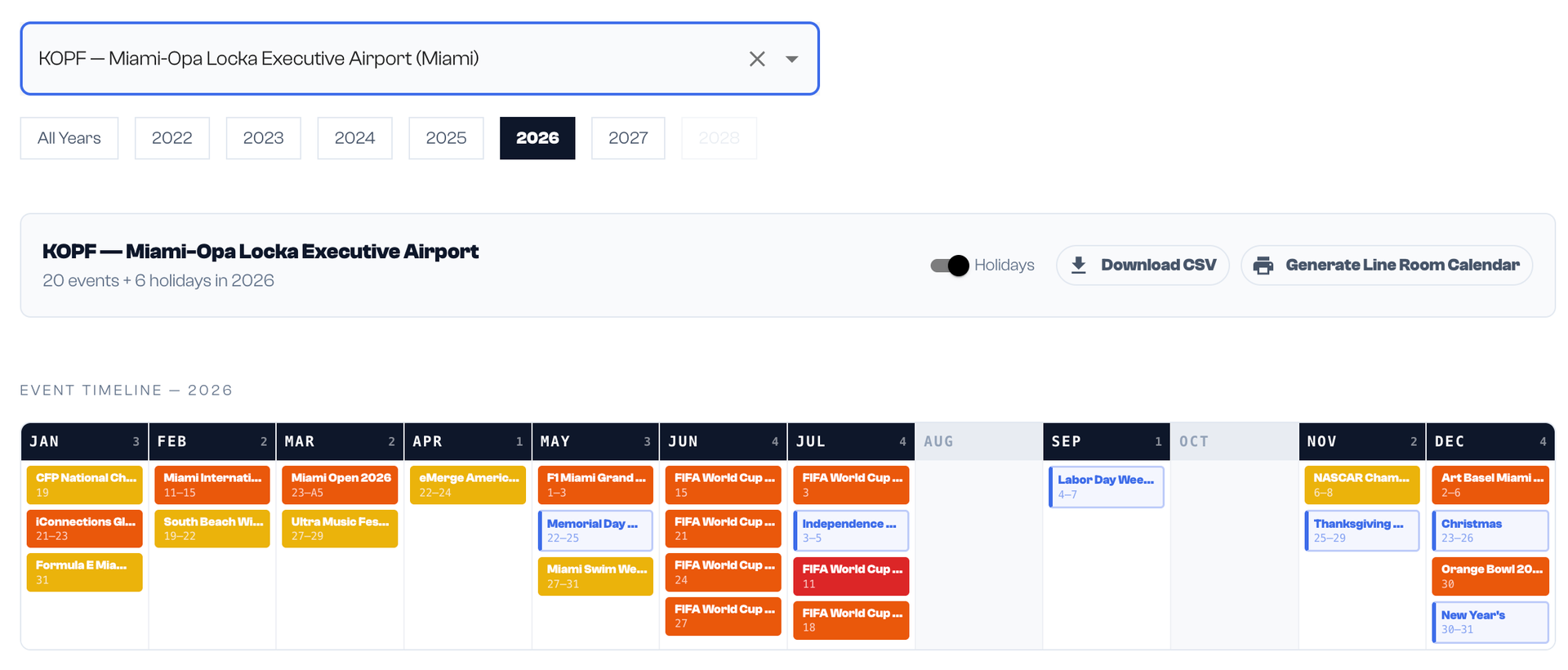
Timeline view for KOPF. F1 Miami Grand Prix, Art Basel Miami Beach, and the four World Cup 2026 group-stage matches at Hard Rock Stadium, all on one bar.
Here's what's in it:
- 1,536 events from 2022 through 2028. Sports, entertainment, luxury and lifestyle, finance, tech, major conferences, and aviation industry events. Each one includes start and end dates, attendance, a magnitude score, and notes on which fields usually absorb the traffic.
- Filter by your airport with 50 km radius matching. Type KPWK (Chicago Executive) and you see Chicago Bears home games, the 2027 Ryder Cup at Olympia Fields, and the Chicago Auto Show, even though none of those events are tagged directly to KPWK in the source data. The calendar reads your ICAO, pulls every event within a 50 km metro bubble, and shows them to you, because that is who actually catches the spillover when the primary field caps out.
- Aviation intensity scores. Super Bowl LX at KSJC is
very_high. Masters week at KAUG isvery_high. Daytona 500 at KDAB ishigh. A regional conference ismediumorlow. One glance tells you whether to staff up or stay normal. - Printable line room calendar. Click "Generate Line Room Calendar" and you get a clean page sized for the wall behind the coffee pot. Events sorted by month, color-coded by intensity. Stick it next to the radio and hand a copy to the weekend supervisor.
- CSV download. Filtered by your airport and year, ready to drop into scheduling software or cross-reference against historical arrivals.
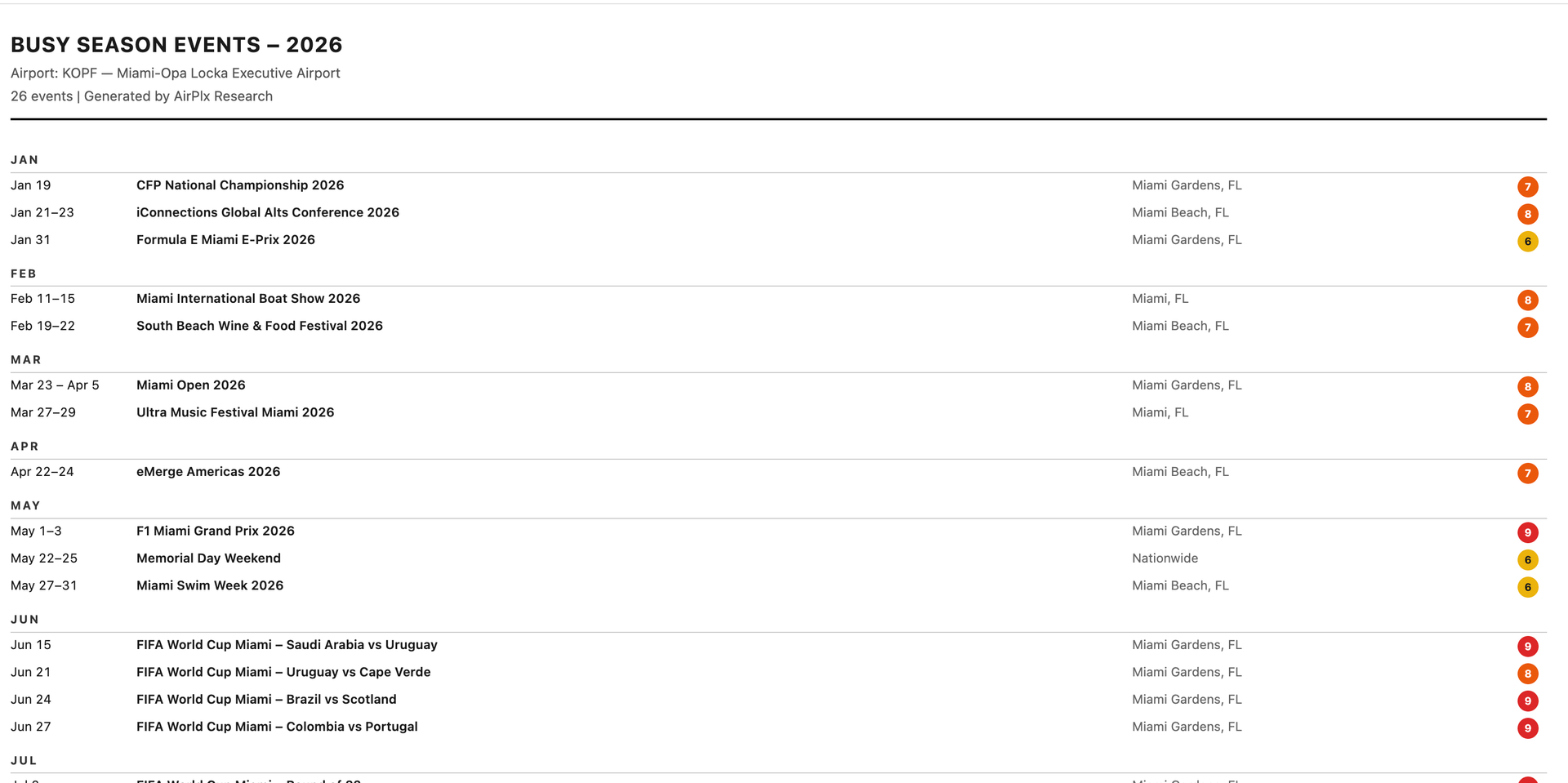
The printable version. Color-coded intensity, no logos, no clutter.
One thing the data actually surprised us with
We expected the traffic peaks to land on the obvious weeks. Super Bowl, Masters, Thanksgiving. What we did not expect was how hard May compresses.
May 2026 alone has 37 events in the dataset, twenty of them rated very_high intensity, and they stack up like this: Kentucky Derby (KSDF), Monaco Grand Prix and Cannes Film Festival overlapping in Nice (LFMN), the F1 Miami Grand Prix (KOPF), Milken at KVNY, Met Gala at KTEB, the Indy 500 at KIND, the PGA Championship, Berkshire Hathaway, Google I/O, EBACE in Geneva, Roland Garros, and SALT Conference in Las Vegas. That is international luxury, domestic sports, finance, and tech all pulling at the same private fleet over four weekends.
December 2026, by contrast, has 10 events. So May has 3.7 times the event density of December. If you are staffing by gut feel on a "summer is busy, winter is slow" heuristic, May is already a month ahead of you.
A timely example: World Cup 2026
The FIFA World Cup 2026 starts June 11 and runs through July 19. It is the single largest event cluster in the dataset, 78 matches across 16 host cities in the US, Canada, and Mexico. Eight of those host metros have never absorbed an event of this scale before, and the overflow fields around each host city are going to see aircraft from operators who have never landed there.
Open the calendar, type KTEB, and every MetLife Stadium match shows up with dates and intensity. Type KDAL for the Dallas matches, KOPF for Miami, KBFI (Boeing Field) for Seattle, KCCR or KOAK for the Bay Area. Change the year to 2027 and the tournament disappears; the baseline calendar comes back.
That is the kind of visibility that should have existed already. It did not, so we built it.
Look up your airport
Open the Private Aviation Event Calendar →
Thirty seconds. Type your ICAO. Print the calendar. Hand it to your line lead before the next big weekend catches you without a fuel truck.
If you spot an event we missed or an airport assignment that looks off, tell us. We update the dataset every quarter.