Planning for High-Traffic Event Weekends at FBOs: Tools and Practices
Published on January 6, 2025 • 6 min read
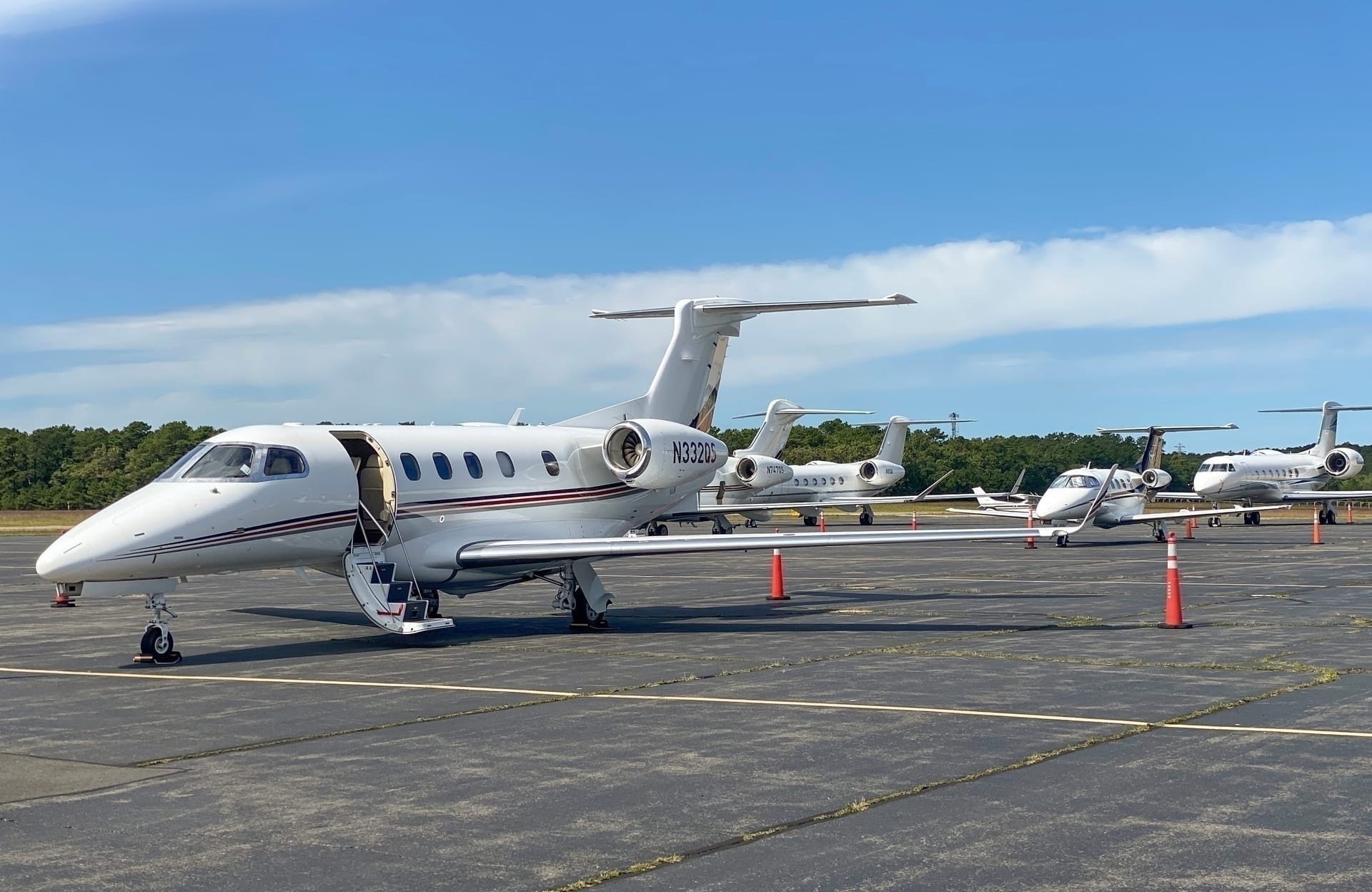
Super Bowl LVIII dumped 3,500 extra flights and 400,000 passengers on Las Vegas airports in a single weekend. FBOs across the valley saw traffic spike 3-4x their normal volume. Some operators captured $50,000-$100,000 in incremental fuel and ramp fees. Others watched aircraft divert to competitors because they couldn't manage the flow.
The Super Bowl typically draws the highest number of U.S. private jet flights of any event during the year, according to WingX data. But it's not alone—Formula 1, Coachella, Art Basel, the World Economic Forum, and major golf tournaments all create similar surges for nearby FBOs.
After talking to operators who handle these events regularly, one thing is consistent: the FBOs that win abandon their normal playbook entirely.
Advance Planning and Early Coordination
Start planning early. Desert Jet Center begins preparations 30-45 days before the Coachella music festival, holding regular meetings with specific agendas and clearly defined team roles. Major international events may trigger even earlier coordination—a year or more ahead—with airport authorities, ATC, customs, and other stakeholders.
This lead time allows airports to consider extraordinary measures (like closing taxiways or even runways for overflow parking) that require significant notice. At SEA Prime in Milan, the team begins planning weeks in advance of Formula 1 or Fashion Week, anticipating not just the surge in aircraft but also their expected length of stay on top of normal traffic.
Assume normal processes will be inadequate. FBO managers approach these events recognizing that their day-to-day procedures won't scale. A 2016 industry advisory noted that an FBO's standard methods for dispatching fuel trucks or handling service requests will likely "break down and fail in a high-density event."
The solution: establish a centralized operations "command center" for the event. Rather than a front-desk CSR trying to radio line staff for each request, all service and fuel dispatching gets coordinated in a dedicated back-office hub. This creates a nerve center insulated from the hectic customer-facing lobby, so the flood of incoming requests can be triaged efficiently.
See how many aircraft fit in your hangar
AirPlx calculates optimized 3D stacking layouts for your exact hangar dimensions.
Run a free layout simulationArrival and Departure Slot Management
Many high-traffic events involve slot reservation programs or prior-permission (PPR) schemes to meter traffic. The FAA, airport authorities, and NBAA often implement special traffic management for events like the Super Bowl.
In practice, each affected airport's FBOs are typically allotted a certain number of arrival/departure slots by the airport or FAA, based on projected ATC capacity. The FBO then books those slot times for incoming aircraft on a first-come basis.
For Super Bowl LVII in Phoenix, "FBOs were given an allocated slot of time by airport directors," and those slots began running out quickly. Operators had to call their chosen FBO to secure a reservation for a landing or parking slot. This essentially turns the FBO into the slot coordinator—staff maintain a schedule of expected arrival and departure times and ensure they don't exceed their allocation.
For events with formal slot systems (like the World Economic Forum in Davos via Zurich), FBOs may have to wait on an official slot release. Cat Air Service in Zurich notes that even when clients request parking and slots early, final confirmation can't happen until the slot coordination system opens (e.g., late October for a January WEF event).
If no formal slot system exists, FBOs improvise their own reservation list:
- Pre-book arrival windows and assign specific time windows for drop-offs or pick-ups
- Recommend drop-and-go operations (where the aircraft won't stay parked) during peak times
- Spread traffic to avoid too many jets showing up simultaneously
The customer service team essentially becomes air traffic schedulers—penciling in ETAs/ETDs and advising late callers that no space remains.
Ramp Parking and Hangar Allocation
Parking space is at a premium during big events. "Parking can become critical," notes Chiara Dorigotti, CEO of SEA Prime. She strongly urges operators to plan trips in advance or pre-book hangar space to avoid last-minute repositioning hassles.
Well ahead of an event, FBOs map out every available spot: ramp coordinators designate parking areas for different sizes of aircraft and decide which planes can go to hangars versus the apron. In extreme cases, the host airport might convert a taxiway or secondary runway into a temporary parking area.
Optimizing the ramp layout is almost an art form. Planners review the types of aircraft expected and adjust the parking plan accordingly. As one event support specialist explained, they analyze previous years' events to predict the mix of aircraft sizes: "Do we need to plan for 70% Gulfstreams, or 70% King Airs? Because that's going to change your footprint and how you can park things."
FBO teams draw up diagrammatic parking plans, fitting wingspans together like a puzzle to maximize use of space while preserving taxi lanes. During Art Basel in Switzerland, weekly movements quadruple (from ~100 to ~400), forcing them to utilize every inch of ramp and hangar. They even make contingency plans for overflow to neighboring airports if capacity runs out.
Hangar allocation is similarly choreographed:
- High-value customers secure hangar reservations well ahead of time
- Long-stay aircraft park in the back
- Aircraft with early departures position toward the front for easy exit
- This staging helps avoid situations where an aircraft is blocked in when the departure rush begins
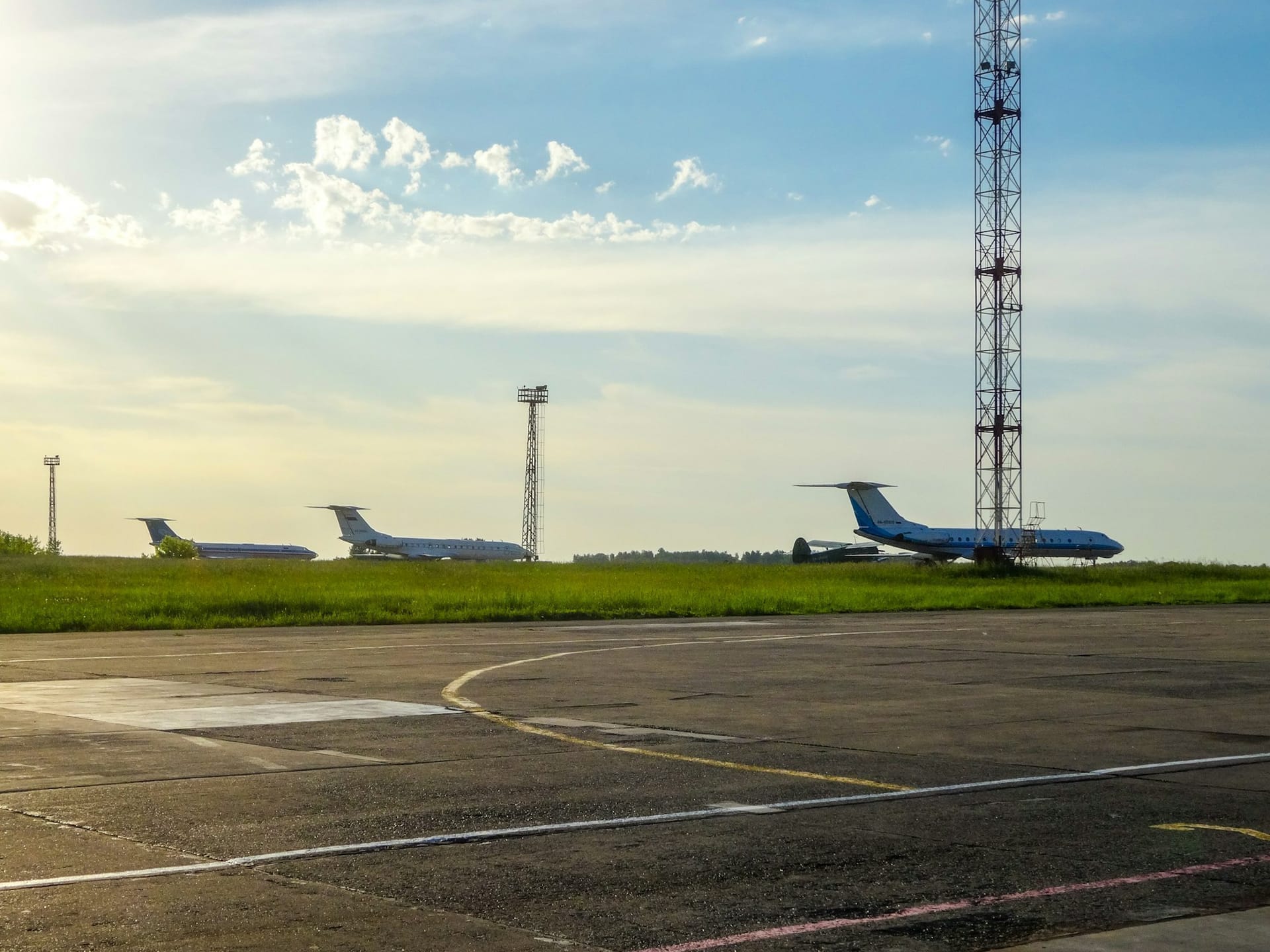 Staged and ready—positioning aircraft for efficient departure sequences
Ground Traffic Sequencing and Ramp Congestion Management
During event weekends, the surge of movements can be 3-4 times the normal traffic volume. Most events have a "compression" profile: hundreds of arrivals flood in the day or two before, then a wave of departures all trying to leave in the hours after the event.
Arrival sequencing: FBOs assign arrival times or sequencing numbers to incoming aircraft when they reserve. As planes call in on the radio, line crews direct them to specific spots or holding areas. At busy fields, aircraft might be asked to hold short of the ramp until a marshaller waves them in, one at a time. Follow-me cars guide jets to parking, ensuring they don't bottleneck. Tight arrival sequencing is crucial because "ramps become congested" and maneuvering space is limited with aircraft parked wingtip-to-wingtip.
Departure rush: The real test comes when everyone wants to leave at once. FBOs designate staging areas for departures—towing aircraft from parking spots to a queue near the taxiway. Extra tugs and tow teams pull aircraft out and line them up in departure order.
Communication is constant: the FBO might have one person acting as a ground "air traffic" coordinator, releasing each aircraft to taxi only when ATC can take them. It's a fast-paced ballet—fuel trucks topping off jets as engines start, tug drivers hustling to reposition, and a line of Gulfstreams and Globals inching toward the active runway.
Critical tactic: Fuel on arrival, not departure. Having all departures try to fuel last-minute can cause hours-long delays on a clogged ramp. By fueling upon arrival, when ramp space is more available and crew are present, FBOs mitigate one choke point during the busy exodus.
To keep the ramp flowing, experienced FBOs "triage" attention and tasks on the fly. A senior ops leader continually prioritizes which aircraft needs service next, which can be towed later, and so on. If an unexpected issue arises—an aircraft goes AOG or a slot gets delayed—the team quickly adjusts the sequence. "Slots, AOG aircraft, or an airspace shutdown can completely block our tarmac... but every problem has a solution," as one Swiss FBO manager put it.
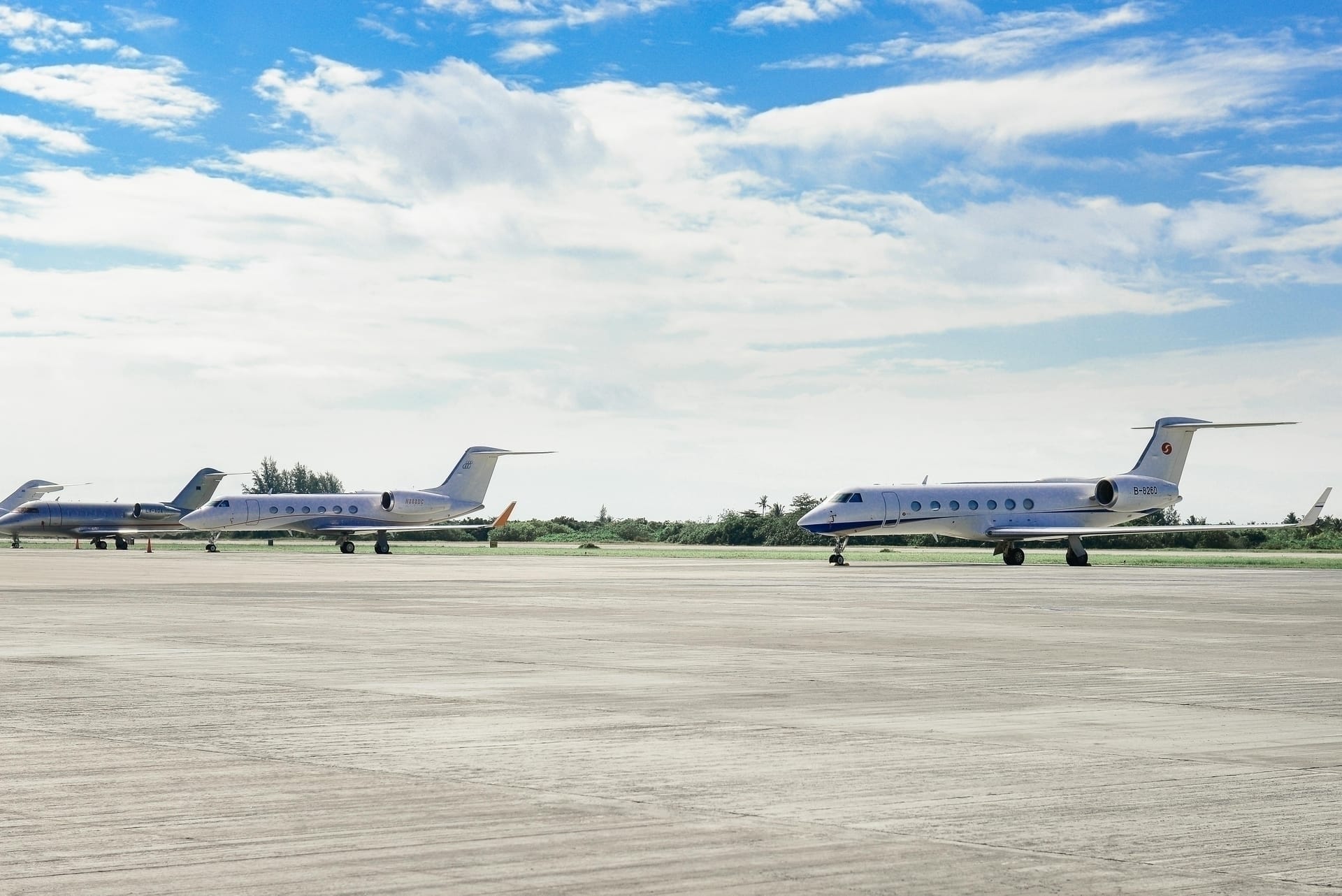 The departure queue forms—tug drivers and line crews choreograph the exodus in real time
Staffing and Resource Augmentation
Handling a major event is an all-hands effort. During Art Basel, Air Service Basel's "entire team is committed"—even accounting, maintenance, and security staff put on FBO vests and act as ramp agents or customer greeters. SEA Prime "boosts numbers in apron personnel, cleaning, and security staff to cover peak times."
Because the local team alone may not suffice, many FBOs borrow or contract extra staff:
- The FBO community "comes together"—an independent FBO can put the word out and friends from far-flung FBOs will send employees to help, wearing a different uniform for a few days as a badge of honor
- Specialized companies (e.g., Jet Event Technologies) assemble experienced crews to deploy on-site—10+ veteran line technicians or CSRs who've been vetted and trained to slot in smoothly
Staffing costs to budget: Contract line technicians typically run $30-45/hour (vs. $15-22/hour for in-house staff), plus travel and lodging if they're coming from out of town. For a 3-day event weekend, expect $2,500-4,000 per contracted worker all-in. Borrowed staff from partner FBOs often work on a reciprocal basis—you send two of yours to their Masters Tournament, they send two to your PGA Championship.
Insurance note: Verify your liability coverage extends to borrowed and contracted workers before the event. Most FBO policies cover temporary staff, but confirm with your broker—especially for high-value aircraft operations. Some operators require contract workers to carry their own $1M liability policy.
Augmenting ground support equipment (GSE) is equally important. An FBO expecting dozens of large jets might rent additional high-capacity tugs, fuel trucks, GPUs, lavatory carts, potable water carts, belt loaders, and baggage tractors. Extra tugs allow repositioning multiple aircraft simultaneously (critical when parking is nose-to-tail) and provide backup if one breaks down.
Equipment rental costs to budget:
- High-capacity tug: $800-1,500/weekend
- GPU (28V): $400-700/weekend
- Lavatory cart: $300-500/weekend
- Belt loader: $500-900/weekend
- Fuel truck (if available): $2,000-4,000/weekend
Most GSE rental companies require 2-4 weeks notice for event weekends—the good equipment gets booked early. Budget $5,000-15,000 total for equipment augmentation depending on expected traffic.
FBOs pre-position spare equipment around the field and stock up on wheel chocks, towbar heads for unusual aircraft, and safety cones/barriers. All rented equipment typically arrives a day or two early so it can be inspected and integrated into the operation.
Communication and Team Coordination
Effective communication—both internally among staff and externally with crews/passengers—is vital. Many FBOs implement a layered communication plan:
Internal coordination:
- Daily briefings and on-shift huddles to update everyone on the game plan
- Dedicated radio channels or group text apps for the event team, separate from normal operations
- Clear role assignments: who is handling fueling dispatch, who is managing valet and rental cars, who is monitoring inbound flight tracking
Handling the phone surge: One veteran noted you "can get bogged down when you have two CSRs trying to run a regular operation and deal with all the incoming calls, traffic and changes." The solution: bolster the customer service desk or have an off-site team assist. Some FBOs enlist administrative staff from HQ or use third-party concierge services during peak days.
External coordination: FBOs send pre-arrival briefing packets to all booked operators—special instructions (slot times, parking assignments, ground transportation info, NOTAMs, parking diagrams). Desert Jet provides "pre-event updates and detailed instructions" to every operator and keeps up a stream of updates during the event as procedures or weather conditions evolve.
On the ground, FBO personnel coordinate with local ATC for smooth hand-offs. Some stations have an FBO representative in the airport operations center during peak departure push.
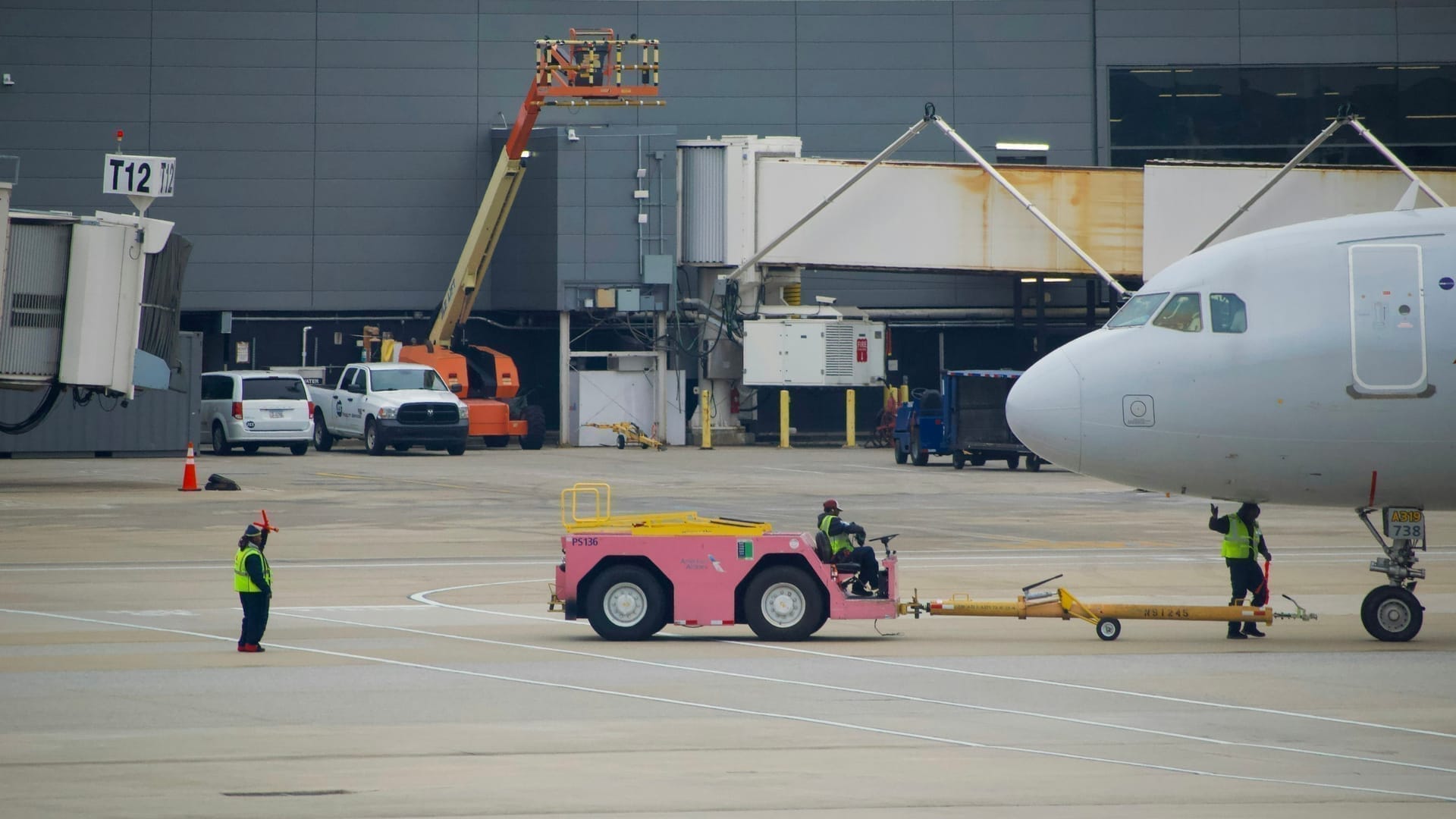 Constant communication between line crews keeps aircraft moving and prevents bottlenecks
Tools and Systems: From Spreadsheets to Software
Despite the high stakes, many FBOs still rely on surprisingly basic tools. Industry insiders observe that there's "a lot of pen-to-paper, and a lot of old-school approaches" at smaller or independent FBOs.
In practice, this means:
- Excel spreadsheets listing each arrival with columns for tail number, ETA, aircraft type, slot time, fuel needs, assigned parking spot, and departure info
- Whiteboard grids with magnets or sticky notes representing aircraft parking positions, re-shuffled as needed
- Paper logs and binders to track what flights are coming and what services are needed
These manual methods dominate because many FBOs lack specialized event-planning software and such events happen infrequently. But the limitations are well known: there's too much information to track in real time, mistakes or oversights hurt safety and customer satisfaction, and invoice reconciliation becomes a nightmare when you're trying to match ad-hoc notes to billing.
Modern FBO software has evolved to address this. Platforms now offer parking planning modules with interactive timelines and maps, allowing staff to digitally assign aircraft to parking stands and visualize capacity in real-time. These tools function like a Gantt chart for the ramp—showing each aircraft's occupancy period and flagging conflicts (e.g., if two jets are assigned the same spot or if a position's size limit is exceeded).
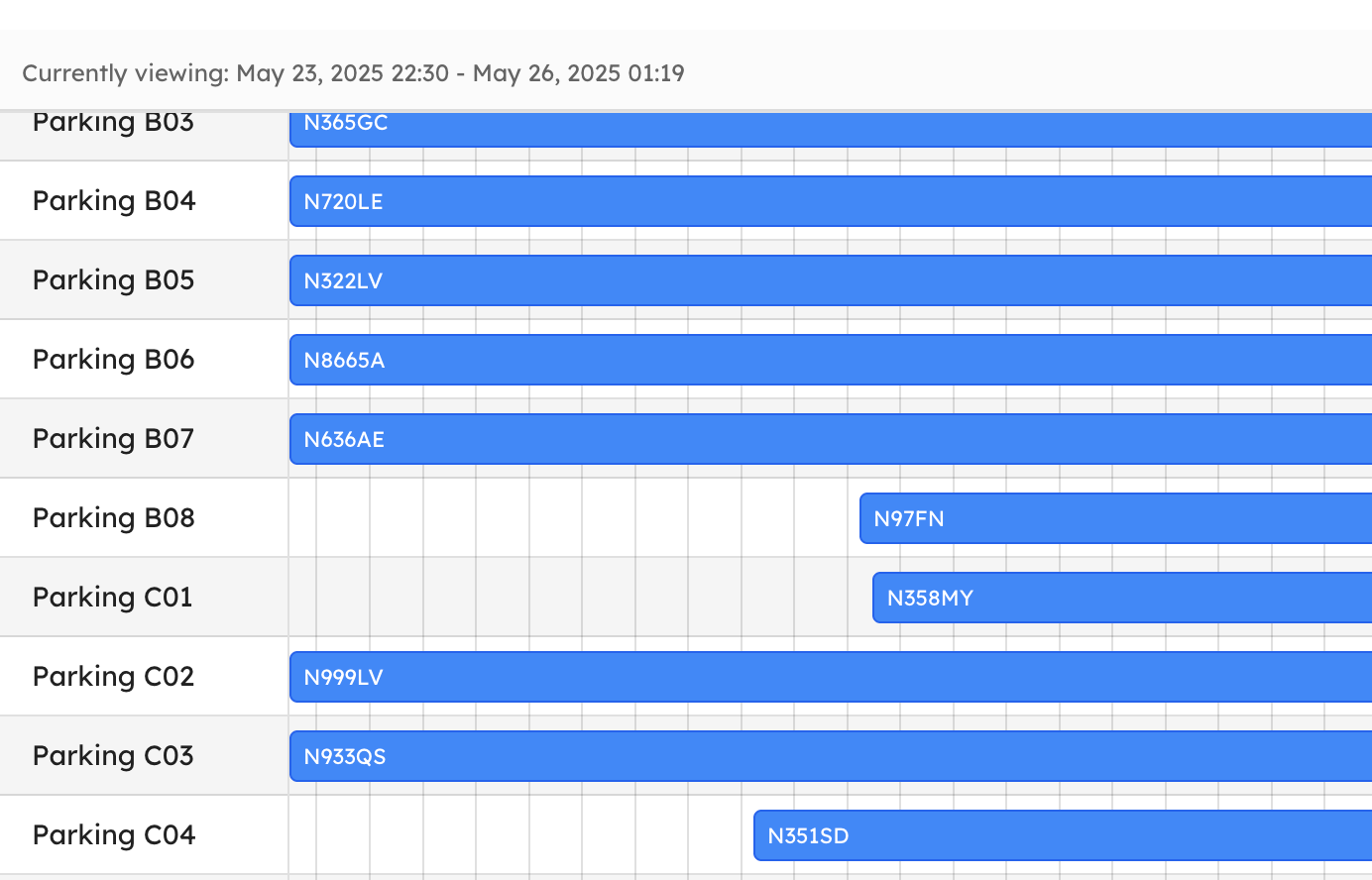 Timeline view showing aircraft occupancy periods and slot assignments
Ramp autoparking features can automatically suggest optimal positioning based on aircraft dimensions, expected stay duration, and departure sequence—the kind of optimization that would take a human coordinator hours to figure out manually. When a last-minute change comes in, the system recalculates in seconds.
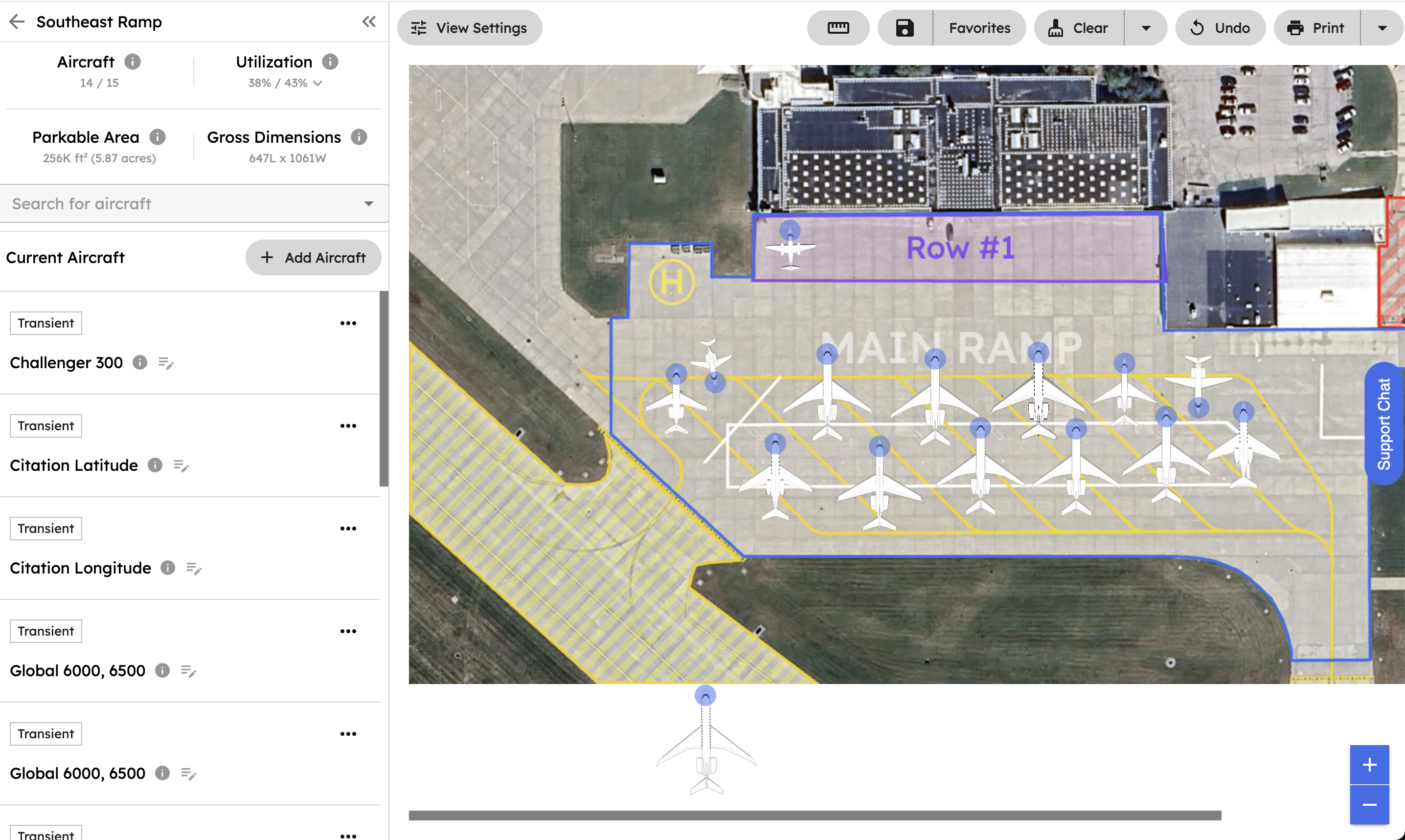 Real-time ramp management with automated aircraft positioning suggestions
That said, even at well-equipped FBOs, these features might be underutilized or the software may be outdated. It's not uncommon to see a high-end FBO with a fancy system still printing out the schedule and marking it up by hand when crunch time arrives.
The priority is always a safe, efficient operation. FBOs will use whatever tools get the job done—whether that's a color-coded Excel sheet, a hand-drawn ramp map, or sophisticated planning software.
The Revenue Opportunity (and the Math)
Private jet traffic to major events continues climbing. The FAA projects business aviation growing 2.2% annually through 2044, with events like the Super Bowl, major golf tournaments, and music festivals representing concentrated revenue opportunities.
A well-prepared FBO can capture:
- Premium ramp fees: $50-150/night vs. standard $25-50 rates during events
- Fuel uplifts: 30-50% higher volume than typical weekends
- Ancillary services: Ground transportation, catering, crew accommodations all spike
Sample event weekend P&L (mid-sized FBO, 60 extra aircraft over 3 days):
| Revenue | |
|---|---|
| Ramp fees (60 aircraft × $100 avg) | $6,000 |
| Fuel margin (45,000 gal × $0.80/gal) | $36,000 |
| Hangar premium (10 aircraft × $200) | $2,000 |
| Ground transport commissions | $1,500 |
| Total incremental revenue | $45,500 |
| Costs | |
|---|---|
| Contract staff (4 workers × $3,000) | $12,000 |
| Equipment rental | $8,000 |
| Overtime (existing staff) | $4,000 |
| Catering/supplies | $1,500 |
| Total incremental costs | $25,500 |
| Net profit from event weekend | $20,000 |
That's one weekend. FBOs near recurring event venues (Scottsdale for golf, Teterboro for fashion weeks, Palm Springs for Coachella) can capture 4-8 of these weekends annually—potentially $80,000-160,000 in incremental profit with the right preparation.
The facilities that treat these weekends as strategic operations—not just busy days—capture premium fees, build customer loyalty, and establish reputations that drive year-round business.
Start planning now. Your next event weekend is closer than you think.
Sources: Business Airport International, AviationPros High Density Operations, FAA 2024-2044 Aerospace Forecast, WingX Super Bowl Analysis, Business Insider Super Bowl Coverage