Aircraft Hangar Size Guide: Dimensions for Every Jet Class
Published on April 5, 2026 • 6 min read
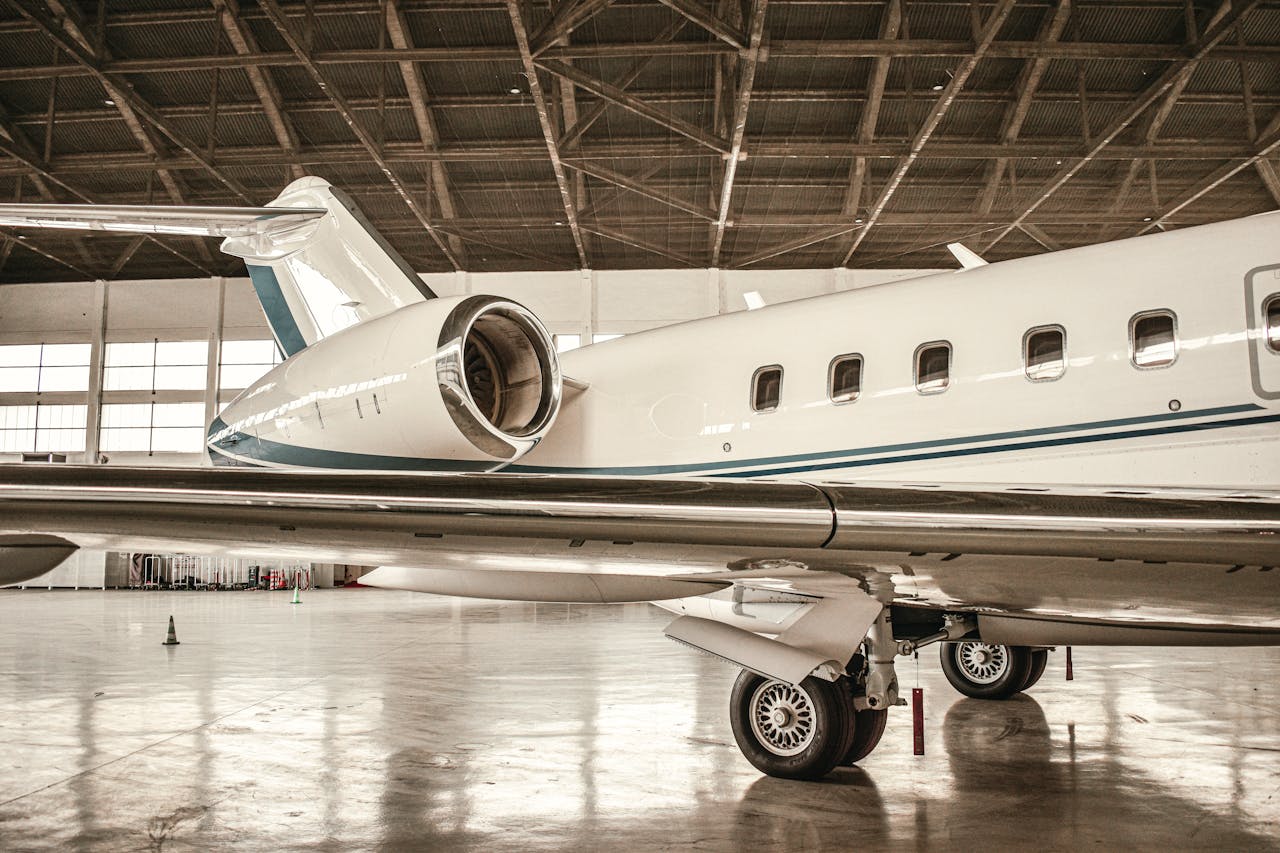
You're planning a hangar build or expansion. The architect asks how big. You say "big enough."
That conversation costs $200,000 in wasted steel -- or $500,000 in aircraft you have to turn away. Hangar size isn't about square footage. It's about three specific dimensions matched to the aircraft you actually serve.
How Hangar Size Is Determined
Three dimensions control everything:
Door height is the hardest constraint. You cannot park a jet taller than your door. A Gulfstream G700 stands 25.3 feet at the tail. A Bombardier Global 8000 reaches 27 feet. Build your door at 22 feet and you've permanently excluded the highest-revenue aircraft class.
Door width determines how many aircraft fit side-by-side. Each aircraft needs its wingspan plus clearance on both sides -- typically 3 feet per wingtip under standard SOPs. A 110-foot-wide door fits one G700 (103-foot wingspan) with just 3.5 feet of clearance per side and no room for anything beside it.
Depth determines nose-to-tail fit with towing clearance. You need the aircraft's length plus 5 feet of nose clearance and 5 feet of tail clearance at minimum. Research from our simulation lab shows that 5 to 15 feet of additional depth can unlock an entirely new aircraft slot -- worth $36,000 to $60,000 per year in hangar revenue.
See how many aircraft fit in your hangar
AirPlx calculates optimized 3D stacking layouts for your exact hangar dimensions.
Run a free layout simulationHangar Size by Aircraft Class
These minimums include standard clearances (3 ft wingtip, 5 ft nose/tail, 10 ft towing lane). Your SOPs may require more.
| Aircraft Class | Example Aircraft | Min Door Width (ft) | Min Door Height (ft) | Min Depth (ft) | Min Footprint (sq ft) |
|---|---|---|---|---|---|
| Single-Engine Piston | Cessna 172, Cirrus SR22 | 45 | 12 | 35 | 1,575 |
| Turboprop | King Air 360, TBM 960 | 65 | 16 | 55 | 3,575 |
| Very Light Jet | HondaJet Elite II, Vision Jet | 55 | 16 | 55 | 3,025 |
| Light Jet | Citation CJ4, Phenom 300E | 65 | 18 | 65 | 4,225 |
| Midsize Jet | Citation XLS+, Hawker 800XP | 75 | 20 | 70 | 5,250 |
| Super-Midsize Jet | Challenger 350, Falcon 2000 | 85 | 24 | 80 | 6,800 |
| Large Cabin | Gulfstream G500, Falcon 6X | 105 | 26 | 100 | 10,500 |
| Ultra-Long-Range | G700, Global 7500, Falcon 10X | 120 | 28 | 120 | 14,400 |
For exact aircraft dimensions -- length, wingspan, tail height, and cabin specs -- see our private jet size comparison chart.
Common Hangar Size Categories
T-Hangar
A single-aircraft shelter, typically with a 42-foot-wide by 12-foot-high opening. Built for pistons and small turboprops. Low cost, low revenue, but high occupancy rates. Most GA airports have dozens.
Box Hangar
Two to four aircraft, typically 60x60 to 80x80 feet with 16-18 foot doors. The workhorse of light jet operations. A well-run box hangar with three Citation CJ4s can generate $120,000-$180,000 annually in hangar fees alone.
Corporate Hangar
Six to ten aircraft, typically 100x100 to 150x150 feet with 22-24 foot doors. Serves mixed fleets from light jets through super-midsize. This is where optimization starts to matter -- the difference between fitting 6 aircraft and 8 in the same footprint is $72,000-$120,000 per year.
FBO Hangar
Ten or more aircraft, typically 150x200 feet and up with 26-28 foot doors. Full fleet spectrum from turboprops to ultra-long-range. These facilities justify 3D stacking software because even a 15% capacity improvement translates to six figures annually.
Door Height: The Most Expensive Constraint
A 28-foot hangar door can cost 40-50% more than a 20-foot door. That premium -- often $150,000 to $300,000 -- buys you access to the highest-revenue aircraft class.
Here's the calculation that matters: large cabin and ultra-long-range jets command $4,000-$7,000 per month in hangar fees. Two of them can pay for the door height premium in one to three years.
The harder question is whether to build for what you have today or what you'll see in five years. Aircraft are getting bigger. The Gulfstream G700, Bombardier Global 7500, and Dassault Falcon 10X all require 25+ foot clearance. If your market sees any of these aircraft, a 22-foot door is a bet that your highest-revenue customers won't show up.
Build-or-wait framework: If large-cabin jets represent more than 15% of your current transient traffic, build for 28 feet. If they're under 5%, a 24-foot door with structural provisions for future height extension is the safer investment. Between 5% and 15%, run the numbers on your specific market using our ROI calculator.
Revenue Per Hangar Size Tier
Not all square footage earns equally. Here's what we see across 100+ FBOs:
| Hangar Tier | Typical Size (sq ft) | Door Height (ft) | Target Fleet | Rate Range | Annual Revenue Potential |
|---|---|---|---|---|---|
| T-Hangar | 1,200-1,800 | 12-14 | Pistons, small turboprops | $200-$400/mo | $2,400-$4,800 |
| Box Hangar | 3,600-6,400 | 16-18 | Light jets | $2,500-$5,000/mo | $60,000-$240,000 |
| Corporate | 10,000-22,500 | 22-24 | Mixed fleet | $150-$400/night | $120,000-$300,000 |
| FBO Hangar | 30,000-60,000+ | 26-28 | Full spectrum | $200-$600/night | $400,000-$1,000,000+ |
The revenue-per-square-foot sweet spot is the corporate hangar tier. FBO hangars generate more total revenue but require proportionally more staff, insurance, and maintenance. Our analysis of one-more-jet economics shows that a single additional midsize jet per week generates $124,800 annually in total FBO revenue (fuel, fees, and services combined).
Clearance Rules That Affect Sizing
Your hangar dimensions need to account for regulatory and insurance clearances beyond the aircraft envelope:
NFPA 409 governs aircraft hangar fire protection and specifies clearance requirements based on hangar classification (Group I through IV). Larger FBO hangars typically fall under Group I or II, requiring fire suppression systems that consume ceiling height and wall clearance.
FAA Advisory Circular AC 150/5300-13B defines taxiway object-free areas by airplane design group, which affects the approach clearance from your hangar door to the taxilane.
Insurance carriers often impose their own clearance minimums -- typically 3 to 5 feet per wingtip and 5 to 10 feet nose/tail. Check your policy before finalizing dimensions. Some carriers require additional clearance for aircraft over $30 million in value.
For a step-by-step method to calculate actual capacity from these constraints, see our hangar capacity calculation guide.
The Bottom Line
Hangar size decisions are 30-year commitments. The right dimensions depend on three things: what aircraft your market sends you today, what aircraft are entering service in the next 3-5 years, and how much revenue you need each slot to generate.
The table above gives you the minimums. The optimization work gives you the maximums. The gap between them is where smart planning earns its keep.
Want to model your specific dimensions before breaking ground? Book a demo to see exactly how many aircraft fit in your planned (or existing) hangar, or run the numbers yourself with our ROI calculator.
Related Articles
Start AutoStacking
See how AirPlx plans, parks, and predicts your ramp moves in one place
 Copyright 2026 • AirPlx, Inc.